June 4, 2026
Using AI to Get More Out of Your Service Operations and Customer Journeys
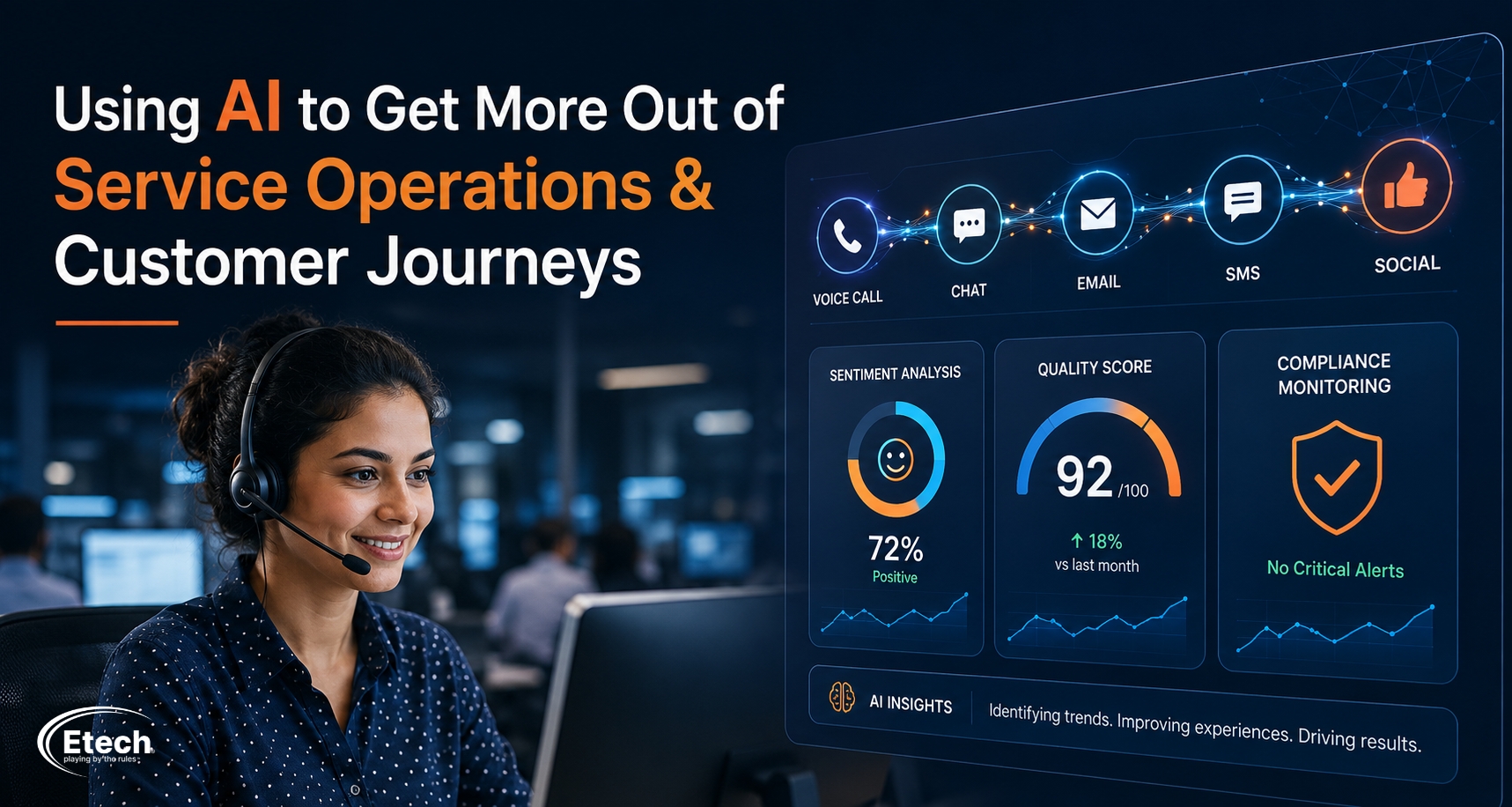
Your contact center already generates more data than your team can act on. Every call, chat, and message carries a signal about how an agent performed, where a customer got stuck, whether a disclosure was made, and which process is quietly costing you. The problem is not collecting that data. The problem is that most of it never gets looked at. Applied well, AI changes what you can actually see and act on. It reviews patterns at a volume no QA team can match and lets you move on what matters before it shows up in your numbers.
Where AI actually moves the needle
AI earns its place against three problems contact center leaders deal with every day: you are only seeing a sliver of your interactions, your supervisors are spending coaching time on the wrong things, and customer experience drifts from one channel to the next.
Most QA programs review 2 to 5 percent of interactions. That means the overwhelming majority of agent behavior, and the majority of moments where a customer experience went sideways, never reaches your leadership team. QEval™ changes that math by scoring 100 percent of calls, chats, and digital contacts, then flagging the ones a human needs to look at. Your supervisors stop hunting for interactions worth reviewing and start spending that time coaching the agents who need it.
The effect on quality scores is not subtle. When programs move from sampling to full coverage, we typically see quality scores climb 20 to 35 points, and QA teams cut roughly 40 percent of the time they were spending on manual scoring. Those recovered hours go back into coaching, calibration, and fixing broken processes, which is the work that changes performance rather than just records it.
AI and agent performance: what the data shows
Agent performance is the biggest lever you have on customer experience. CSAT, First Call Resolution, and Average Handle Time all come back to what an agent says and does on the interaction. The value of AI-assisted coaching is timing. It shortens the gap between what happened on a call and when the agent hears about it.
In practice, a supervisor gets a prioritized coaching list instead of a stack of random samples. QEval™ identifies the specific behaviors that matter, the phrasing that tends to trigger escalations, the response patterns that pull down FCR, the spots where required compliance language is missing, and surfaces them agent by agent. That lets a supervisor run a focused session tied to a real interaction the agent recognizes, which is exactly why that coaching tends to stick.
None of this replaces an experienced supervisor’s judgment. It takes the administrative load off their plate so they can do the part of the job they are actually good at, which is developing their people.
Improving customer journeys through interaction intelligence
Your CX strategy is only as good as the data behind it. Plenty of organizations track NPS and CSAT at a summary level but cannot connect a score that dropped to the specific behavior or process that caused it. Analyzing interaction data closes that gap.
Run sentiment analysis across your full interaction volume and you can see where customer effort spikes, which contact reasons create the most friction, and which resolution approaches actually land well. That tells you what to change in your routing logic, your scripts, and your knowledge base, and you get it on a timeline that reflects what customers are dealing with this week rather than what an annual review surfaces months later.
This pays off most in omnichannel programs. When voice, chat, email, and digital contacts all run through the same analysis, you start seeing patterns across the whole journey instead of inside one channel at a time. A friction point in chat that pushes customers to call shows up in the data before it turns into a systemic problem.
Compliance and risk management at scale
If you operate in financial services, insurance, healthcare, or telecom, compliance monitoring is not optional. The hard part is doing it without blowing your budget or creating new exposure in the process. Sample-based QA cannot reliably catch a compliance event, because most calls are never reviewed in the first place.
Running interaction analysis at 100 percent coverage changes your risk profile. QEval™ monitors required disclosures, prohibited language, and regulatory phrasing on every interaction. Automated redaction of PCI, PII, and PHI data means a healthcare or financial services operation can move to full coverage without opening up a new compliance gap to do it.
What you end up with is a compliance posture that does not depend on luck of the draw. When a regulator asks whether a required disclosure was made on a specific call, you answer from the record instead of an educated guess.
What to think through before you start
You do not need to rip out your technology stack to get results from AI. The approach that works starts narrow: one program, a defined interaction volume, a short list of measurable objectives, and you build from there based on what the evidence shows.
The questions worth answering up front are straightforward. How much of your interaction volume gets reviewed today? Where is your supervisory team actually spending its time? Which quality or compliance metric leaves you most exposed right now? Those answers tell you which application will pay back fastest.
Change management matters as much as the technology you pick. Your supervisors and QA team have to trust the output before they will act on it. That trust comes from a system that is clear about how it generates a score and that keeps humans in charge of the decisions that count. The programs that bring frontline teams into the rollout, walking them through how the model works, where it surfaces information, and how it backs up their judgment rather than overriding it, reach adoption faster and hold their gains longer.
The case for AI in your operation
AI does not make running a contact center simpler. It makes it more visible. The interactions that matter most, the ones carrying compliance risk, driving escalations, dragging down FCR, and shaping how customers feel about you, become findable and fixable instead of buried in volume.
If you are running hundreds or thousands of agents across complex programs, that visibility is what consistent performance is built on. Quality scores go up when your supervisors can coach against complete data. Customer journeys improve when you catch friction before it compounds. Your compliance posture gets stronger when every interaction is monitored rather than a sample that was never large enough to begin with.
The technology is a tool. The decisions it puts in front of you, and the people making those decisions, are what move the numbers.
If your program still runs on sample-based QA and manual scoring, you are making decisions on incomplete information. Etech Global Services partners with enterprise contact centers to close those coverage gaps and build quality programs that hold performance steady over time.
Talk to our team about your current quality program, or take a look at our contact center services to see how we build AI-supported programs that produce measurable outcomes.

Patrick Reynolds serves as Etech’s Senior Vice President of Business Development & Client Solutions. Since joining Etech in 2000, Patrick has held multiple leadership roles and has been instrumental in building and scaling Etech’s global operations. In 2005, he played a key role in training the first outbound and inbound teams at Etech’s Gandhinagar, India facility—laying the foundation for what has now grown to a team of 600+ professionals across sales and support functions. Patrick is known for fostering meaningful client relationships and delivering tailored, results-driven solutions. In his current role, he leads strategic business development efforts and partners closely with clients to unlock new growth opportunities and strengthen long-term trust.
