March 16, 2026
Culture Wins Championships and Customer Loyalty
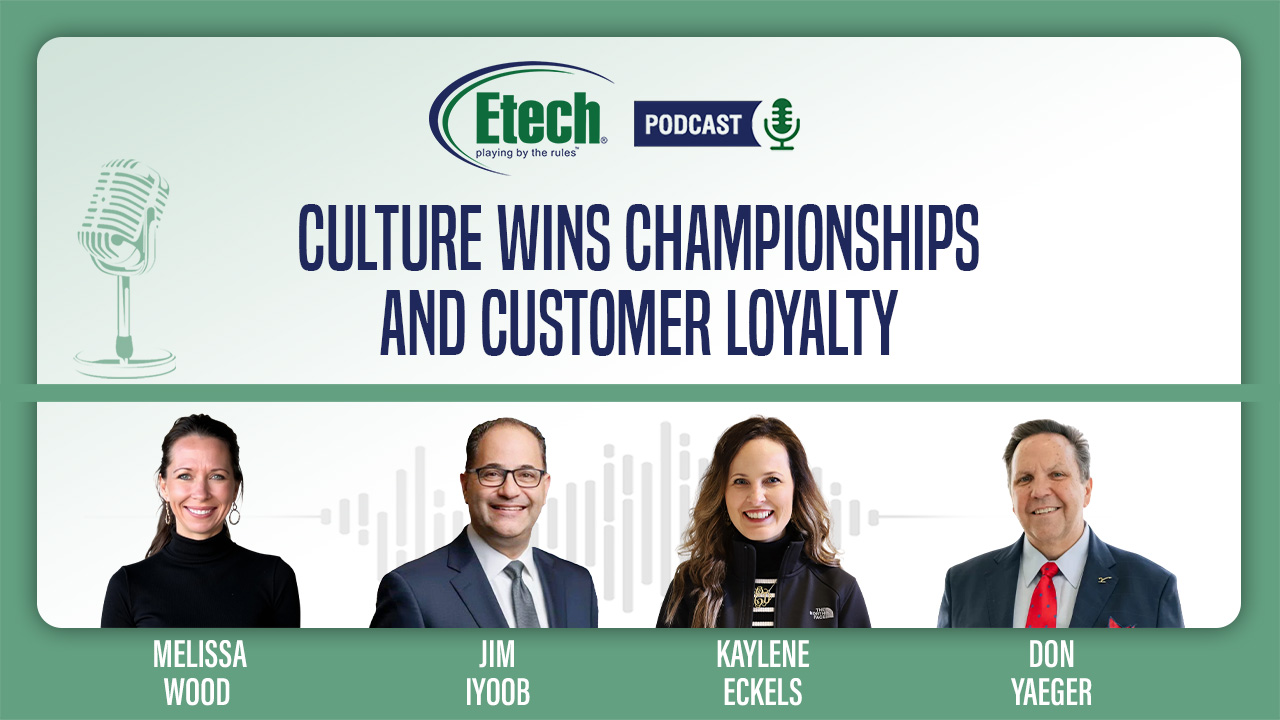


Final Video
0:00
Hello everyone, welcome to the E Tech Leadership Table.
0:03
This is a podcast where we invite you to pull up a chair, grab a cup of coffee and join us as we tackle some remarkable discussions on everything leadership.
0:13
I’m Melissa Wood, I’m your host.
0:14
I’m the Dean of leadership development of E tech Global Services.
0:20
Hello, podcasters, and welcome to the E tech leadership table.
0:24
You better buckle up, put your boots on, whatever you need to do because you’re not going to believe who we have on screen with us today and you’ll see his bio.
0:33
You probably already know anybody’s face, but we have the most incredible leadership speaker of all times, Don Yeager.
0:41
Don, welcome to our to our team this morning.
0:44
Melissa, thank you so much.
0:45
And not sure I deserve that, but I will accept it it.
0:49
Thank you very much.
0:51
Well, I want to say, Don, I have something to tell you.
0:54
You and I are going to be spending the next 30 days together and you don’t even know it really.
0:59
I signed up for your leadership online courses.
1:04
Well, thank you.
1:05
You may not.
1:05
I was trying to figure out because because I actually leave in a couple days for the for the Winter Olympics in Italy.
1:10
And I was thinking you’re going with me and I didn’t even know it.
1:13
How great is that?
1:15
We’ll see.
1:16
I’ll be spending time with you.
1:17
You may not be spending as much personal time with me, but I’m going to spend 30 days and hopefully some warmth of Texas weather and not the Olympic.
1:25
Oh my gosh, I’ll watch it for sure.
1:27
So in case some of you will will load Don’s bio everywhere, you’ll be able to see it.
1:33
I encourage you to go watch everything you can possibly watch, especially his podcast, the corporate competitor podcast.
1:40
You’ll see Kayleen.
1:41
She’s the president of E Tech and Gem Iube is the president of our ETS Labs, and they are here today to kind of help me spend some time with Don.
1:51
That’s all we’re going to do is spend some time.
1:52
We’re going to pick his brain and let me just maybe introduce Don in a different way.
1:59
He is the most curious, courageous individual I’ve never met in person.
2:06
Seriously.
2:07
He, he, if you’ll go and do some research about Don, he tackles some some subjects that people stay away from.
2:16
And I believe that that curiosity and that ability to do that has helped him mold who he is today.
2:21
He’s met some of the most incredible powerful leaders, corporations around the world.
2:30
The last I heard he had 4 million delta airline miles.
2:33
I don’t know how many you have now.
2:36
So it’s it’s a little past that and they look good.
2:38
I’m flying Delta to to Italy.
2:40
So they’ll keep adding up.
2:43
They’ll keep adding up.
2:44
I hadn’t met anyone that had more than gem IU, but you definitely you have more than that.
2:49
You know, Don, everyone calls you the great storyteller and I, as I’ve listened to you and I and I go, you’ll listen to your stories.
2:57
I think about, you know how you said your dad was a Methodist preacher and you grew up, you know, just blue collar, you know, and probably watching him share the word And there’s there’s something different I want to say about your storytelling that I picked up for what it’s worth.
3:12
Is it you don’t just tell the story like there’s a layers.
3:16
You’re teaching truth underneath the story.
3:20
And I think that that is what makes you so incredibly unique.
3:23
And I’m sure your dad did that when he was sharing the, you know, we can tell someone about Jesus, but he’s when you tell a story about Jesus down on the cross, people just see that story.
3:32
But there’s so many stories underneath that.
3:34
And that is your true gift.
3:36
And that is, to me, so impactful.
3:38
And that’s why you just have a legacy of that storytelling.
3:42
It’s more than that.
3:43
It’s it’s just the depth of which you’re able to do it.
3:45
And there’s just so many lessons that you can learn.
3:47
You can listen to it three times and go back and pick up a different lesson.
3:50
And I think it’s incredible.
3:51
So thank you for your life’s work.
3:53
And I can’t wait to see what you do next.
3:56
Thanks, Melissa.
3:56
I will tell you, my father used to say all the time that the the two of the greatest storytellers of all time were Jesus Christ and, and, and Adolf Hitler.
4:07
And so the bottom line is, you know, stories move people, right?
4:10
Stories get people to go places they would typically go do things they wouldn’t traditionally do.
4:17
If you tell the story properly, you can move nations.
4:21
Both of those men did it and for vastly different reasons and with, with greatly different outcomes.
4:28
But the bottom line is that that’s the power of story, right?
4:32
You want to understand what story is?
4:34
It’s not, it’s not always used for good, sadly.
4:37
But but in that process, you know, we we’re able to kind of learn and grow and get better.
4:44
Well, it’s definitely a gift and we appreciate you sharing that with us.
4:47
Well, we have a few questions because we want to be so selfish and just be so curious and steal your steal your time.
4:55
And I know there is tons of other podcasters.
4:58
Joe Rogan probably signs on to this podcast just so he can watch you, I’m thinking.
5:02
But we just have a few questions and we’ll let you go.
5:05
So thanks again for sharing your wisdom with us.
5:08
Question #1 All right, you ready?
5:10
Yeah, let’s play.
5:10
I know that you, you start, you studied sports teams and you even have a formula.
5:16
I I saw for you know what makes great teams, but what is 1 cultural trait?
5:21
You’ve seen so many cultures, you know, even in the businesses and and sports.
5:27
What do you see?
5:27
What culture consistently separates championship teams from just your your basic ones?
5:34
I would cultural attribute if, if that’s what you’re looking for, I would tell you that the number one that I see among the best teams is truth telling.
5:44
It’s the ability to understand that not everything you’re going to hear in this environment is going to make is going to please you.
5:53
But as long as you understand that everything you hear is shared with you only because it’s for the good of the whole, right?
6:03
That if you, if you understand that you can accept criticism, you can, you can, you can take feedback that you wouldn’t typically take because you understand that it’s being offered to you in, in that spirit.
6:18
And so the spirit of truth telling is A, and, and it’s really amazing because if you look at great teams, one of the things you’ll discover is that that everybody’s always looking at the leader to find out.
6:31
They, you know, they, they profess certain things right about family or good way.
6:38
And then, you know, then you suddenly watch them kind of iron up the secretary as she’s down the hall, right?
6:43
And, and it immediately erodes any, any faith they have in the truth you’re going to share with them.
6:49
So as you’re thinking about truth, telling it and you understand its role and its power within your organization, just know that everybody will be watching to find out how, how committed are you to that to to that attribute.
7:07
If that is 1 you, you share with others that, that you, that you define your leadership around.
7:14
Oh, that’s powerful.
7:15
I, I took a, I’ve been married 32 years and I, I took, I love to take courses.
7:21
And so I took a like a marriage course.
7:24
It was a, it was a live event and the late they were wonderful.
7:28
Oh, they were precious.
7:29
This, this man and woman were precious, but she, they were going to break and she forgot to put her phone on mute and her camera off.
7:35
She started screaming at her husband.
7:37
So I mean, it was awful.
7:39
It was absolutely awful.
7:40
And I thought that’s, that’s, that’s a perfect message of what you’re saying.
7:44
Like, you know, we want to sell one thing, but we want to deliver and not we want to deliver behind the scenes and others.
7:50
Well, and there you are right here we are.
7:52
How, how many years ago was that?
7:54
It was during the pandemic, actually.
7:56
So there we are six years ago.
7:57
And, and what do you remember about the entire event?
8:00
Is that, that right?
8:03
And, and I heard you tell us, I heard you in one of your keynotes talk about the company that you know, you, you like.
8:10
Don’t be 6, don’t be late to a meeting, right?
8:13
But they allow people to be 6 minutes late to, to a meeting, right?
8:16
The culture, culturally, they say.
8:18
And then again, I’ve seen organizations as I’m in a lot of them to try to either coach or to do other work, You know, they, they may declare something like exactly that.
8:27
Don’t we, you know, we start every meeting on time because it shows respect, you know, for, for everybody on the team to be on time shows respect.
8:37
But everybody knows you actually start everything 6 minutes late, right?
8:41
Or whatever it is.
8:42
And so it whatever, it’s not what you declare, it’s what you abide.
8:46
It is your culture that’s perfect.
8:48
Abide.
8:51
Thank you for that.
8:52
I hope you pie.
8:53
I hope you podcasters are taking fierce notes or recording this or going to hit replay.
8:59
All right, I haven’t.
9:00
I actually saw I saw Jim pick up his crayon.
9:02
I mean, that was like that’s not my crayon.
9:04
And he he usually writes with the purple 1.
9:07
So I’m super impressed that he took the red 1 today.
9:09
So that’s my note too for making a win.
9:11
I got your notes too, but I do too.
9:14
I’ll go back and watch it 100 times.
9:15
I can’t wait just in the next 30 days with Don.
9:17
So I just can’t wait.
9:19
OK, See you in Milan.
9:22
Oh, that sounds awesome.
9:24
All right, in a business where leaders often talk about strategy, I don’t know how much you know about our organization, but we just left a strategy planning session.
9:35
Culture has been very important to us at etech, but we’ve got a lot of pushback.
9:40
You know about culture first, So can you tell us about leaders who often talk about strategy, but you emphasize culture.
9:51
What does culture does?
9:52
Does it really matter more than strategy because we get pushed in the other end?
9:56
They’re like a culture doesn’t make money, right?
9:59
By the way, the culture makes all the money.
10:01
I’m going to, I’m going to share with you that at the end of the day, that it, you can have the greatest strategy on Earth, you can have the greatest bottom line for this particular year that you’ve ever had.
10:18
But without the proper culture, without the, without this, without this understanding that we are, we’re actually all part of something unique and we’re all part of it together, right?
10:30
If that, that culture doesn’t allow you to believe that together, everything you experience will be temporal.
10:38
And, and what you’ll find is that that the highs will might, might be high, but the lows are going to be miserable.
10:46
And so culture allows you to to, to develop a, a foundation that that is far more important.
10:53
And, and I’m by the way, this is not Don Yeager preaching.
10:56
This is Don Yeager, having spent a lifetime with great teams, telling you what the best teams do, how you know we’ll go sports and you know their names.
11:09
I could throw out there that like Nick Saban, that will probably drive half the audience crazy and the other half are going, oh, what a great guy.
11:16
You know, Steve Kerr at Golden State, Anson Dorrance at the North Carolina women’s soccer team.
11:23
Every one of these great leaders, when you ask them, how do you go about how do you build the organization the, the, the team that wins year in and year out, they will tell you it is a start.
11:34
They start with culture and and everything begins and ends there.
11:39
That that’s so powerful.
11:41
It brings me back when I when I first heard you tell the story about the basketball team that spent the time at the military base.
11:49
Yeah, Arlington and how they would.
11:53
I won’t go into your story.
11:54
It’s not my story to tell.
11:55
You’re the best at it.
11:55
But just you literally, I was driving down the road listening to you and I I was just in tears.
12:00
I’m not a tears kind of person.
12:02
But when when you said that when the players would do something remarkable, how they would salute the camera, right?
12:11
It it almost pressed me.
12:13
I mean it, it literally could.
12:14
And that’s what you mean.
12:15
That’s the culture.
12:16
Like these were these definitely they knew how to play the game of basketball.
12:20
But when you told that story about them saluting the camera, that’s when someone understands that culture when makes all the money.
12:28
Yeah, culture is where it is.
12:30
It it’s the it’s the driver.
12:32
Anyway, I share that with you because you know, I’ve spent a, I’ve spent a lifetime just studying high performance, high performing teams, high performing individuals.
12:43
That’s my, that’s, that’s my jam, right?
12:45
That’s where I want to be.
12:46
That’s where I want to learn from.
12:48
I’m, I’m grateful that you open by talking about curiosity.
12:53
You know, I, I’ve, I’ve, I’ve had bosses in the past tell me I don’t have the greatest IQ.
12:59
You know, some days my EQ is not that great either.
13:03
But my CQ, my curiosity quotient is, is, is generally off the charts and so remarkable.
13:10
I can’t remember how many companies and leaders like you just went in and just ask questions and stuff.
13:15
I mean, it’s it’s incredible.
13:17
So I’m honored that they let me, which is, you know, if you’re, if you’re lucky enough to let folks, if they’ll open up to you, then, you know, how disrespectful would it be to not come as well prepared as possible and to ask questions that they probably weren’t prepared for?
13:39
That’s incredible.
13:40
All right, well, I’m going to, I’m going to.
13:41
I wrote this basketball over to to Kayleen because I know she’s got a well look at she even like she even was ready.
13:48
She had both hands open, right?
13:49
Had her thumbs in, thumbs in, right.
13:53
Yeah, she’s she’s ready to accept the pass.
13:56
Kayleen.
13:57
I don’t know how much, I don’t know how much how much hoops you played, but that was beautiful.
14:01
That was strong.
14:03
I see what you did there.
14:04
I like it too, Don.
14:06
And I’m a huge Green Bay Packers fan, so Lombardi Trophy all the way.
14:11
It’s almost like you teed up my question for me because you were talking about championship teams and I I’ve heard you talk about that.
14:18
They don’t necessarily have the best or the most talent.
14:23
They’re the ones where the leaders really have mastered the art of making every person feel genuinely valued.
14:31
And I love that so much.
14:33
And I was hoping you could just give us an example based on your experience talking to all of these great coaches and athletes and business leaders, of an example that really stood out to you, where someone did that exceptionally well.
14:49
Yeah, I’ll, I’ll share one with you right off the right, off the wall behind me.
14:54
I’m a, I’m a huge fan of Mike Shashefsky at Duke, right.
14:58
Who was the basketball coach at Duke?
15:01
And you know, when he was there, he won five national championships, right?
15:06
Only John Wooden has won more.
15:07
So what an incredible what an incredible achievement.
15:10
But but his second to last national championship was won by a team that only had eight scholarship players on available to play because of injury or transfer other issues.
15:24
They had eight scholarship players.
15:26
Now, you know, a typical basketball team has between 12 and 13 depending on, on on on what division they’re playing in.
15:34
So basically, they had a third fewer players than of scholarship quality than everybody else.
15:41
They didn’t even have enough players to practice, right?
15:45
You need 10 guys to practice.
15:47
But they get to the NCAA tournament and Coach K decides, you know what?
15:52
Let’s, let’s make sure that this team understands what it means to play for each other and to play and, and to have someone out there that you value.
16:05
And so he asked every player and he asked the eight players.
16:09
He said, I’d like each of you to, to scribble down for me the names of three to five people that when we win the national championship, you will immediately call to say this was for you.
16:24
Tell me, was it your grandmother, your, your, maybe your, maybe your, your, your mom, maybe it was your uncle or some coach in, in middle school who give me 3 to 5 names of someone that if you’re, if you win, you get to call them and say, I was thinking of you as we, as we played this game, right.
16:46
So players did that.
16:47
Then he had everyone talk about their three to five.
16:50
And then as they got ready for their first game in the NCAA tournament, they showed up and in the locker room, 8 players had their lockers.
16:59
The 9th locker was reserved for a basketball that just had the names of all of those people on the on the ball.
17:07
And, and, and everybody knew.
17:10
Like that’s a reminder that that’s who we’re playing tonight for, right?
17:14
We’re not playing for the TV audience.
17:16
We’re not playing.
17:17
We’re playing, we’re playing for something special, right?
17:20
And when you’re, when you’re working for something special, when you’re doing something for someone special, you show up with a, a different level of discretionary energy, right?
17:30
You show up capable of doing more than most people might imagine.
17:35
And as they travel through that NCAA tournament, the ball traveled with them.
17:40
It it had a spot in every locker room, right?
17:44
And then when they when they finally won the national title, Coach K took that ball and he counted the number of names on it.
17:53
And he went out and had had that many balls created with all those names on it.
18:00
And every player got to deliver a ball to somebody they were doing it for, right?
18:06
Now you talk about what I mean, they had eight guys, right?
18:09
That’s it.
18:10
Playing teams that had 12 had had depth far greater than theirs and, and, and several of their eight were freshmen, right?
18:18
And so they weren’t, it wasn’t they, they didn’t have the most talent.
18:21
They didn’t have the greatest they, they didn’t have the deepest roster.
18:25
They had many things that you would argue were in fact would, would, would disqualify you in the minds of most for, for excellence.
18:35
But they had something the rest of them didn’t.
18:37
And that was that they knew they were playing for someone in each of their lives and and everybody knew who each other who they were all playing for.
18:46
Yeah, that’s because they all talked about it.
18:48
That’s amazing.
18:48
I’m taking I’m taking that story and paying it forward here at E Tech and outside of E Tech.
18:54
That’s that’s amazing.
18:56
And just so you know, one of our claims to fame here in Nacogdoches, TX SFA beautiful moment for us was when we beat Duke.
19:08
So we’re still living off of that, John, one time.
19:12
I get it.
19:12
Mercer has the same.
19:14
It’s like there’s no hang up on us now because of that.
19:17
Kaylee, are you kidding me?
19:19
I look, I mean, it meant something, you know?
19:22
But you know, we’re still living on it, right?
19:24
What’s cool is that so there’s another school kind of about the same size Mercer that beat Coach K and then Duke in the NCAA tournament a few years ago.
19:34
And and after coach talked to his team, he walked over to the Mercer locker room to congratulate the players.
19:40
Because by the way, it’s you know, in the end of the at the end of the day, right, we’re not, we’re not curing cancer.
19:46
We’re not, we’re not, we’re, we’re, we’re we’re doing something that’s important, but it’s not so important that we can’t still be amazing humans.
19:55
And so anyway, that’s incredible classic.
20:01
Yeah, OK, so it looks like we’re going to need some basketballs at E Tech and we need to write some names.
20:05
That’s I’m just telling you absolutely, that’s incredible.
20:09
Coach K was he just did tons of things like that.
20:14
He’s masterful.
20:15
He’s masterful because he’s constantly his curiosity quotient is that guy.
20:22
He is constantly thinking, how do I make others believe they’re capable of something greater than they probably should be?
20:32
And if you’re asking yourself that question, you’ll come up with really amazing and creative ways to pull people in, to draw them to become part of your team in a way that that others just plain mess.
20:44
Well, I want you to keep your eyes on the sky because you’re going to see our company’s name.
20:49
We, we may not win basketball.
20:50
We could win basketball championships.
20:52
Who knows?
20:52
Jim May, he may pull a glory out.
20:55
We don’t know.
20:56
We’re just going to let Jim just as long as Jim’s not jumping center.
20:59
That’s all I want to tell you.
21:02
And I think I heard you call those fill it moments.
21:05
Is that what moments?
21:06
It’s where you feel it’s where you feel who you are serving, right?
21:15
And and serving can come in a lot of different ways.
21:18
But but this idea that it’s not who you’re necessarily selling to, right?
21:24
It’s who you’re serving.
21:26
You might sell to a company that then does something special in the community.
21:33
Who you are really serving is the community, not the client, because without you, the client probably doesn’t do what they need to do for the community.
21:42
Yeah, that’s so powerful.
21:46
That’s really good.
21:48
That reminds me of like what we do at E Tech because we are passionate about giving back and what we do is an enabler for us to give back.
21:55
Our team is hungry to give back.
21:58
We have sawmill 6 that we do as a give back that supports the SFA players here.
22:05
So is that why they’d be do love hearing you say that?
22:08
No, he, he does have a great story about the Dream Team.
22:13
And then later, was it 6 years, they finished sixth in the in the world.
22:18
You know, 10 years later they finished sixth in the world.
22:20
Yeah, it’s amazing.
22:21
You think about that, right?
22:22
You go from the dream Team, best team of all time, and 10 years later you’re, you’re 6th in the world.
22:27
It’s because, as often happens in organizations, you get quite full of yourself.
22:32
You become quite confident that that, that, that everybody else is wishing they could be as good as us.
22:40
And, and that that complacency, which is human nature is what what, what actually destroys many organizations from within.
22:53
You know, that’s one of the things we talk about all the time.
22:55
If you really want to be exceptional every single day, you’re defying human nature because human nature is to be average.
23:05
And in my opinion, the age of average is over.
23:10
You’re dropping these quotes, Don.
23:12
You know, You know, we’re going to be quoting you now forever on these things.
23:17
Jim, I’d like that painted on all of our center’s walls.
23:20
The age of average is over.
23:23
I wrote that one down.
23:24
Well, it’s over.
23:24
I love that.
23:25
OK, as a visionary, I can I can lock in on that one.
23:29
All right, Don, we know you’re trying to get to the Olympics, and we understand.
23:32
I cannot even believe we’re talking to Don Yeager and it’s Super Bowl weekend.
23:35
Like, I’m not even believing this.
23:36
It’s pretty good deal.
23:38
So we just have a couple more questions for you.
23:43
How do the way teams treat each other internally show up in the experience that customers receive externally?
23:49
Oh my gosh, that is such a great question.
23:51
But but also what I mean the, the bottom line is that the, the customers are what customers experience is what we do to and for each other, right?
24:08
I mean, and how we, how we treated that, that point of how we treat each other, it shows and, and, and they feel it right.
24:15
They customers understand whether or not they’re working with an organization that that says all the right things or one that does all the right things.
24:26
It’s a, it’s a very, it’s a very easy distinction to make.
24:29
And it can generally be made within about 3 to 5 minutes if somebody’s really watching your organization.
24:36
Nothing I love more than to watch than to go to than to go to dinner with a group of executives and see how they treat the waitress, right?
24:45
That tells me everything.
24:47
See how they how they react to the busboy.
24:49
See if on the way to the garage there’s trash on the ground, if everybody walks right by it, right?
24:54
I’m looking for those things because that tells me, you know, we could have all the platitudes in the world.
25:01
We can, we can and, and at the end of the day, what you really want is it, it shows up in, in the, in the way others are treated and the way they’re treated is what I did a book that comes out later this year with the CEO of Delta Airlines, Ed Bastian.
25:20
And, and Ed actually has what, what he argues is his, his golden circle, like how, how to run a business.
25:31
And he believes, you know, all those companies who talk about, well, the customer’s always first.
25:35
The customer is, you know, is the, or profit is first.
25:39
We got to make sure we, we take care of our shareholders, right?
25:42
He said, by the way, the angle is employees are first.
25:46
If you treat your, he calls it his virtual virtuous cycle.
25:50
If you treat your employees right, you get, you do for them what they never experienced working for someone else.
26:00
You treat them right.
26:02
And what happens is your employees try to treat your customers right.
26:06
And they do so because they’re so proud to actually work someplace where they know they’re being decently taken care of.
26:13
And if they treat your customers right, your customers treat your bottom line right, right.
26:18
You know, they, they suddenly stop thinking they’re, I mean, Delta has made its money.
26:23
Delta has become the number one and most profitable airline in the world by running a very premium product in a in a world that was on a race to the bottom just a few years ago, right.
26:35
And through deregulation, every airline in the world was doing its very best to try to create.
26:41
The only differentiator was am IA dollar less than you.
26:44
And Delta said, you know what, we’re not going to play that game.
26:48
We’re going to be more expensive, but the but it’s but if you appreciate being treated well, you’ll pay for it.
26:57
And guess what?
26:58
It’s proven itself so right that now other airlines are trying to model themselves up to after.
27:03
I mean, United Airlines is working like crazy and openly saying we’re, we’re trying to be like Delta, which I think says a lot.
27:11
I I, the one that sticks to my head the most is I’m like, Don, I look at, you know, the waitress all and stuff, but you don’t want my biggest pet peeve is have you gone to the supermarket and you see the people who don’t put their carts back in the cart?
27:28
That drives me insane because I think really because I see the poor kids pushing, going, collecting all the carts.
27:37
That’s one of my biggest FPS when I go to a grocery store when I see these parents just leaving that cart right where it was don’t even put it back.
27:44
Sorry out of that.
27:47
Now we know how to tick Jim off.
27:49
This is that’s right.
27:50
Next time, next time you see Jim at the grocery store and you really just try to get under his skin, roll over and leave a cart next to his car just for almost do they sell carts on Amazon or have it delivered to his front doorstep?
28:02
That’s what I that’s what I need.
28:04
All right, Jim, since your buddy, this is your buddy, obviously he’s quite quoted buddiness.
28:09
Let’s let you wrap it up with the last question.
28:12
Well, thank you so much.
28:13
So, Don, first of all, I’m humbled for you to even help us and, and beyond this, I mean more than you could imagine.
28:19
When we met, you were just a, a regular person.
28:23
I shared a lot with you about me, my career, my bosses, my problems, and it was just amazing what you taught me and those two painstaking days you had with me.
28:35
But I’ve enjoyed it probably more than you.
28:37
But my question is a simple one because I’m AI consider myself a continual learner.
28:44
But like, if you think about customer experience, you know, that’s that’s really where I play in the customer experience, specifically in the contact center space and the artificial intelligence stuff we do.
28:56
But if, if, if people wanted to learn how to build this championship culture, which you’ve taught us tremendously today, right?
29:05
Like, like if they want to do that, what would be the one action that you think they would have to take to actually start doing it?
29:16
And tomorrow, let’s say like one thing they can take away, they can start tomorrow.
29:23
I would argue that I think the the most important, and this goes back to our opening, right curiosity.
29:27
I think one of the most important things is what do you know about your customers?
29:33
And, and as you try and, and, and, and you might start in the macro, right?
29:38
You might know, well, on average our customer earns this or on average our customer spends this or whatever those things are.
29:46
And then you want to start breaking it down because the people buy from people they like.
29:55
We’ve all heard that, right?
29:56
But by the way, people like people like them.
30:01
And so if people like people like them, you have to know enough about them to try to figure out, are we like them?
30:08
And can we, can we convince them that they are like us and that we actually have things in common.
30:17
People buy from people they like and people like people that are like them.
30:21
So if you can get to know your customers better and as you do find ways to take advantage of that, right?
30:31
I, I do something really, I’m, I’m a sports guy.
30:34
We’ve established that.
30:35
You look at my backdrop, you see all kinds of sports related things.
30:40
There have been people who have accused me of robbing A fanatics store, but I’ve got I’ve got things that matter to me from people who matter to me.
30:50
And but one of the things that I do in my outlook right in mine in the notes, when I have a file for people in their in their notes, I’m I, I make note of things like, Hey, Kayleen Echols is a Green Bay Packers fan.
31:07
So, you know, one of these days, maybe in the next 20 years when the Packers win a win a Super Bowl again, I’ll send.
31:17
I told you guys he was he he’s a fighter.
31:20
He’s a curious fighter.
31:25
Yeah.
31:25
My one of my employees actually said to a group of our interns a couple of years ago that my love language is sarcasm.
31:32
And so if if you’re trying to figure out if I like you or not, it’s going to be usually by the level of sarcasm brought to the conversation.
31:39
But I would have in the notes portion of my outlook of with a, with the, my Kaylee Echols card, right?
31:47
It would say Green Bay Packer fan and what it would allow me to do.
31:51
And this is a great thing for those of you who are in the world of sales, right?
31:54
What do you know about people?
31:56
Because something big happens for the for the Packers.
31:59
I can simply go to my outlook type in Green Bay Packers.
32:03
It will come.
32:04
It will reflect back to me the people I have in my database who love the Packers and I can simply without any agenda.
32:13
I’m not asking them for anything.
32:15
I’m not selling anything to them.
32:16
I could send them a quick note going, Hey, big night for the Packers.
32:21
I’m sure you’re I’m sure you’re enjoying it.
32:23
And there’s somebody out there going, Damn, Don Jaeger remembered me tonight, right.
32:28
And it’s a it’s it’s not a it’s not a momentous.
32:32
It’s not something that I mean didn’t take didn’t take a genius to figure it out.
32:36
Clearly I’m not and so the idea is what can you do to know your customer better so that you can then relate to them differently.
32:47
And if you can relate to them differently, they will become your customer for life.
32:51
So that is amazing and it reminds me of what we do at E TAC, believe it or not, for our employees, we have getting to know you sessions to actually have a conversation and you just gave us some really good advice.
33:05
First of all, I’ll start taking this one because I never took it down to that level.
33:09
Love to know my employees, what’s important to them, getting to know you married parents, what’s your goals, blah, blah, blah.
33:15
Never looked at it from the other side of it.
33:17
That was very helpful for me and hopefully the audience as well.
33:21
That was good.
33:22
You close, you close loop it.
33:23
I mean, it’s not.
33:24
I mean, it’s one thing just to get information, but it’s another thing 10 years down the road.
33:28
Get a message about it right.
33:31
That’s powerful.
33:32
And I had no idea that you were a bigger trash talker than Larry Bird.
33:36
I didn’t know.
33:37
I didn’t know.
33:37
You kidding me?
33:38
I’d love me some Larry Bird.
33:40
And he and I, he and I would open a waste management operation together if we could.
33:46
Well, that’s fantastic.
33:47
We, we appreciate your time so much and please be safe on your trip.
33:52
Have a wonderful time.
33:53
I can only imagine what your little brain is going to be soaking in all the curious, the conversation.
33:58
It’s actually going to be fun because this is the first.
34:00
I’ve been to several Olympics in the past, but this is the first one I’m attending as a fan.
34:06
I’m literally just going to sit in the crowd and chant and yell and have a good time and just be be an American.
34:16
It’s going to be kind of cool.
34:18
I’m not going to be a journalist.
34:19
I’m going to be I’m just going to be a fan.
34:21
Am I going to see you salute the camera?
34:23
If it pans to you, you you can count on it.
34:25
OK, thank you, Don.
34:26
I’ll be as long as the Chinese haven’t just scored.
34:29
I’m not going to I’m not going to salute the camera if the Chinese score.
34:31
So what what are you want?
34:33
Like what is like your your number one you have to see when you go.
34:39
I’m looking forward to seeing luge.
34:42
I I think that’s just a, I mean, you’re putting people in a tin can and you’re running them at 100 miles an hour down a tube and hoping on the other end there’s some way to stop.
34:53
I mean, it’s a, it’s a crazy, I, I, I’ve never seen it.
34:57
And so it’s, I’m looking forward to it.
35:01
You know, Jim is probably looking for curling, but that’s OK.
35:04
Well, Jim’s out practicing with his little brush, right?
35:08
Yeah, absolutely.
35:09
I have the brush.
35:11
Thank you so much for your inspiration.
35:13
Thanks for challenges.
35:14
And, you know, again, in that area of curiosity, I think everything you said really ties back to really caring enough to be curious.
35:21
And so we appreciate your time.
35:24
We appreciate the the the work that you’ve done in the past.
35:27
And we look forward to seeing all the amazing things that you’re going to teach us in the future.
35:31
And I’ll be seeing you every day the next 30 days.
35:33
So you just go have fun.
35:35
All right, thank you all very much.
35:37
Have a good day.
