September 2, 2026
AI in the Contact Center: Where It’s Actually Working in 2026
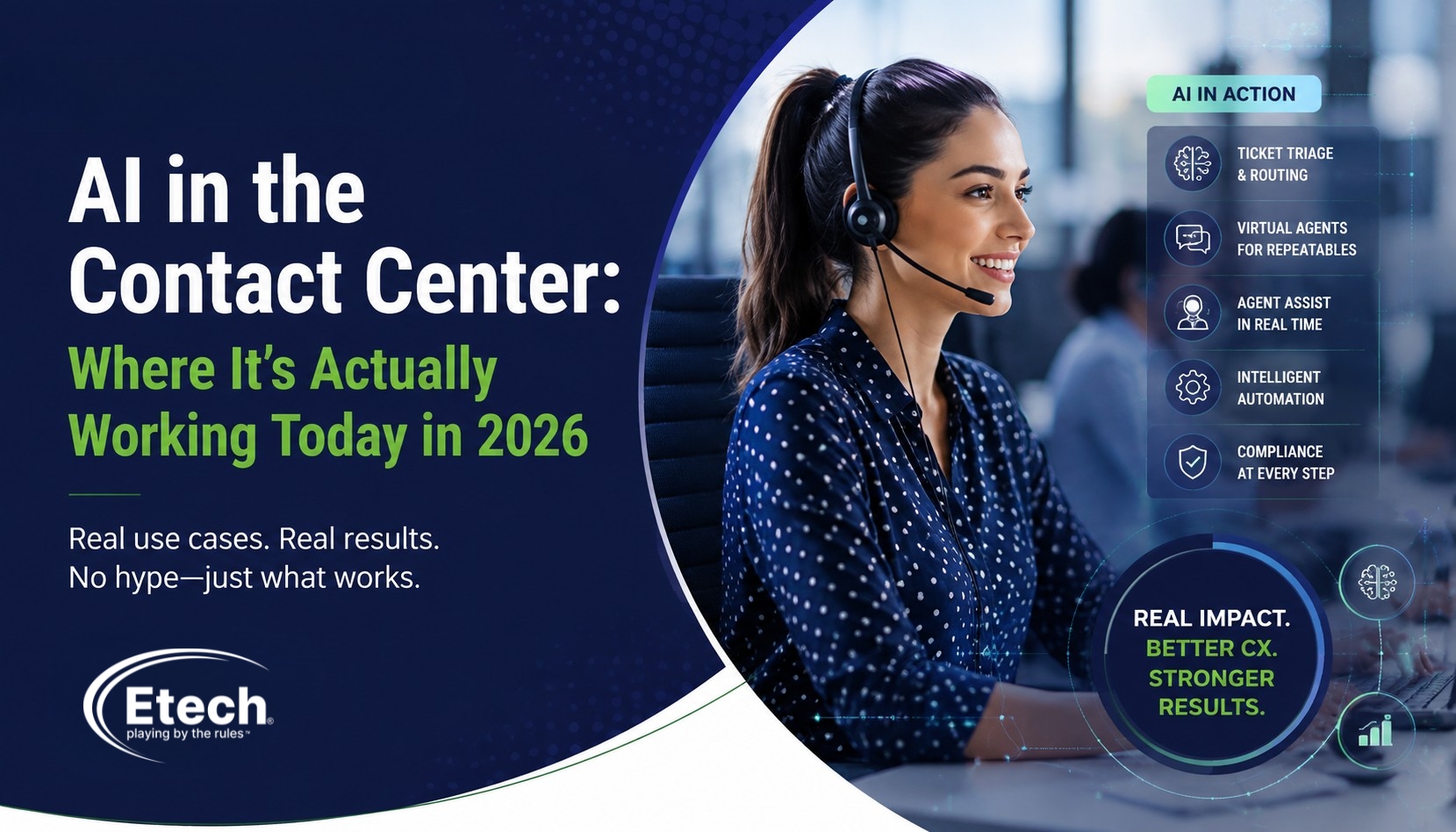
Every contact center vendor now claims an AI story. Most of those claims fall apart under one question, and I ask it in every demo I sit through: what does the system actually do on a live interaction, without a person cleaning up behind it? The answer is narrower than the marketing suggests, and more useful once you know where to look. Here is where contact center AI is producing measurable results today, and where it is still borrowing against a promise.
Ticket triage and routing is where AI earns its keep first
Strip out the vendor language and one unglamorous question is left: can a system read an inbound ticket or interaction, tag it correctly, and route it to the right queue before a person ever touches it? This is the AI use case with the clearest return, because it removes manual sorting work rather than trying to replace judgment. A ticket misrouted at intake costs a customer a transfer, a repeated explanation, and a contact center the handle time it cannot get back. Across more than two decades and 2.5 billion interactions managed, misrouted tickets are one of the most common, and most fixable, sources of wasted labor cost we see in a program, which is why triage and routing is usually the first place worth automating, not the last. If your intake accuracy is still in the low 80s, fix that before you buy anything that talks to a customer.
Virtual agents handle the repeatable, not the judgment calls
Most buyers evaluating a virtual agent or conversational AI want the same thing: something that resolves password resets, order status checks, and appointment scheduling without a queue wait. That is a legitimate, well-defined slice of contact volume, and a virtual agent scoped to it performs well because the correct answer does not change from one customer to the next. The failure mode shows up the moment the interaction requires judgment, an exception to policy, or genuine empathy. Treating those two categories as the same problem is where most virtual agent programs lose credibility with customers, and once that credibility is gone the containment number stops mattering to anyone above you. A virtual agent built to recognize the boundary and hand off cleanly, with full context attached, outperforms one that tries to stretch past its actual capability.
AI agent assist has the fewest reasons not to use it
AI agent assist tools that surface the right knowledge article, suggest a next step, or flag a compliance requirement in real time support the person handling the interaction rather than replace them. Because a human agent is still making the final call, the risk profile is lower than a fully self-directed system, and the return shows up faster: less time searching for the right policy, fewer escalations caused by an agent guessing, and more consistent answers across a team. Assist also exposes something most operations would rather not look at. In a good share of the deployments I have reviewed, the first 30 days turned up a knowledge base problem, not a technology problem. Handling a full conversation start to finish is a fundamentally different bet than assisting a teammate mid-call, and contact centers that start with assist tools before attempting full automation tend to get a cleaner read on where automation actually belongs next.
Intelligent automation works behind the interaction, not instead of it
Intelligent automation and customer experience automation get discussed as if they are about the conversation. They are not. They are about everything around it: after-call summarization, data entry into a CRM, updating a case record, or connecting a resolved chat to a follow-up email without an agent copying information by hand. This is where automation removes the most repetitive minutes, and the labor cost that comes with them, from an agent’s day, with the least customer-facing risk, since none of it happens in front of the customer. A contact center that automates this layer first, before touching the live interaction, usually sees the fastest and least disruptive gains. It is also the easiest business case to defend, because after-call work is a number your workforce management team can already produce.
Compliance is where a person still has to review the work
Compliance-sensitive interactions in insurance, financial services, and healthcare are where automation without review creates real exposure, and this is also where vendor accountability matters most. A BPO partner that can show a client every interaction was reviewed, not sampled, is answering a different question than one that reports on a subset and asks for trust. That is why our team at ETS Labs built QEval® for 100% interaction coverage instead of the 2 to 5% sampling standard most of the industry still runs on, and why it scores what the AI handled alongside what a person handled. It is also part of how Etech has operated with zero compliance breaches across more than two decades of Fortune 500 programs: automated or not, every interaction gets scored, and the ones that need a person get flagged for one.
Start with your own volume, not the vendor’s demo
The vendor pitches will keep promising more than a single live interaction can deliver. The more useful starting point is internal: which categories in your own ticket and call volume are repeatable enough to hand to a system, and which ones genuinely need a person’s judgment. Pull your last 90 days of interaction volume, sort it by that question, and bring the answer into your next vendor conversation. It changes the meeting. You stop being sold a platform and start scoping a problem.
Automation only pays off when it is pointed at the right work. Talk to Etech Global Services about where that line sits in your contact center, or see what our team at ETS Labs is building to score and support every interaction, not a sample of them.

Jim Iyoob is the Chief Revenue Officer for Etech Global Services and President of ETSLabs. He has responsibility for Etech’s Strategy, Marketing, Business Development, Operational Excellence, and SaaS Product Development across all Etech’s existing lines of business – Etech, Etech Insights, ETSLabs & Etech Social Media Solutions. He is passionate, driven, and an energetic business leader with a strong desire to remain ahead of the curve in outsourcing solutions and service delivery.
