July 14, 2026
How Do I Turn Call Center Data Analysis into Actionable Business Intelligence?
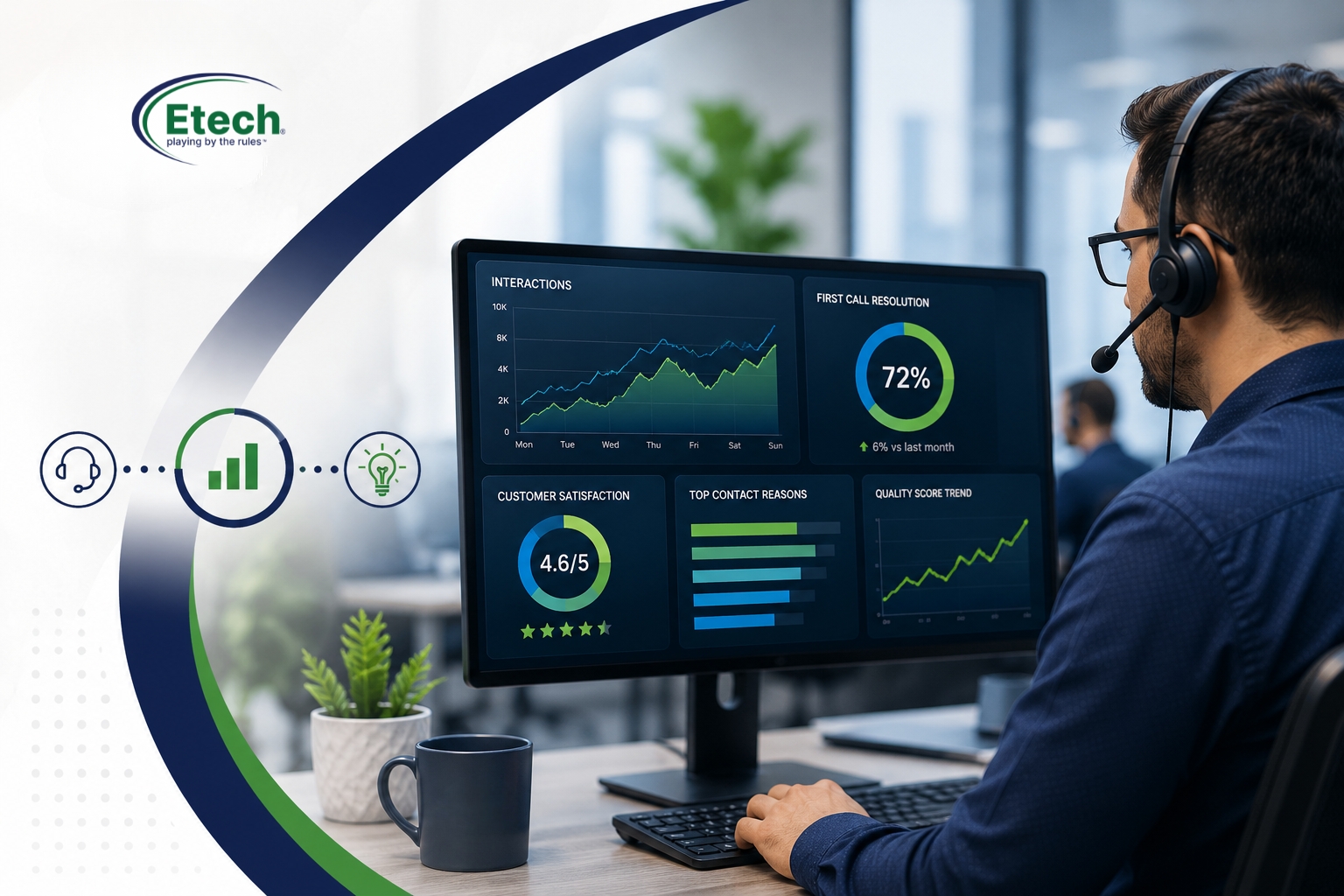
Contact centers generate substantial volumes of data call recordings, transcripts, handle times, resolution rates, and satisfaction scores, but most of them remain under analyzed. The gap between data collection and business decision-making is where operational advantage is consistently lost.
What Data Does a Contact Center Actually Produce?
A mid-sized contact center handling 10,000 interactions per day generates both structured and unstructured data. Structured data includes average handle time (AHT), first call resolution (FCR), transfer rate, hold time, and CSAT scores. Unstructured data, call recordings, chat transcripts, and agent notes are harder to interpret at scale but contain the highest concentration of actionable signals.
Most operations capture structured metrics automatically. The unstructured layer is where analysis stalls, because it requires speech analytics, natural language processing, or systematic quality monitoring to extract patterns from.
Why Most Contact Centers Stop at Reporting
There is a meaningful difference between a report and business intelligence. A report tells you FCR dropped from 74% to 68% in a given week. Intelligence tells you why, whether a specific product issue is driving repeat contacts, a training gap opened after a process change, or a particular call type is failing at resolution.
Making that leap requires connecting data sources that typically sit in separate systems: interaction recordings, CRM data, quality scores, workforce management records, and post-contact surveys. Without that integration, contact center analysis remains siloed and too slow to inform real decisions.
Four Steps to Move from Data to Decisions
- Define the business question first. Start with the outcome you want to influence, such as reducing churn, improving FCR, or cutting cost per contact, and work backward to identify which data sources contain the relevant signals. Collecting data without a defined question produces reports, not intelligence.
- Implement full interaction coverage in quality management. Organizations that sample 2–5% of interactions statistically miss most of what is actually happening in their contact centers. Analyzing the complete interaction set exposes systematic patterns in agent behavior, customer friction points, and compliance risk that sampling cannot reliably surface.
- Connect interaction data to downstream business outcomes. Map quality scores and resolution data to customer retention rates, repeat contact rates, and escalation patterns. This is what converts contact center metrics into language that operations, finance, and product teams can act on.
- Establish a cadence for intelligence review. Dashboards that no one reviews on a set schedule produce no operational change. Assign ownership of key metrics to specific roles and build weekly review cadences that carry authority to initiate coaching or process changes.
Which Metrics Translate Most to Business Outcomes?
Not all contact center KPIs carry equal business weight. FCR has the strongest correlation to both CSAT and cost, and each percentage point improvement in FCR typically reduces repeat contact volume, therefore lowering cost per resolution. AHT matters, but only when read alongside quality scores. A low AHT paired with declining quality scores signals a speed-accuracy trade-off that raises downstream costs through repeat contacts and escalations.
Customer effort score (CES) and post-contact satisfaction data are leading indicators for churn risk in subscription and service businesses. These metrics frequently surface problems before they appear in operational data.
Making the Data Work Across Departments
Contact center business intelligence has the most value when it reaches the teams that control the variables driving contact volume: product, billing, operations, and marketing. A speech analytics finding showing that 22% of inbound calls in a given month relate to a specific billing change is directly actionable for finance and product, not only for the contact center. Build the distribution model for that intelligence as part of the program design from the start.
Put Your Interaction Data to Work
Etech Global Services has managed 2.5 billion customer interactions across telecom, financial services, and healthcare. Our approach connects interaction analytics directly to measurable business outcomes, from quality score improvement to FCR and CSAT performance gains. If you are building or restructuring a data-driven quality management program, connect with our team to understand how other operations have developed this capability.

Manu Dwievedi is Vice President, Product Strategy & Innovation at Etech Global Services and ETSLabs. He leads the roadmap for QEval, Voice AI, Real-Time Agent Assist, and Process Automation, the AI platforms running inside Global 2000 enterprise contact centers. Manu joined Etech twelve years ago as a chat representative and worked through operations, training, quality, and analytics before moving into product strategy. He holds an MIT certification in Data Science & Machine Learning.
