July 3, 2026
Why Is Security Awareness Training Important for Employees?
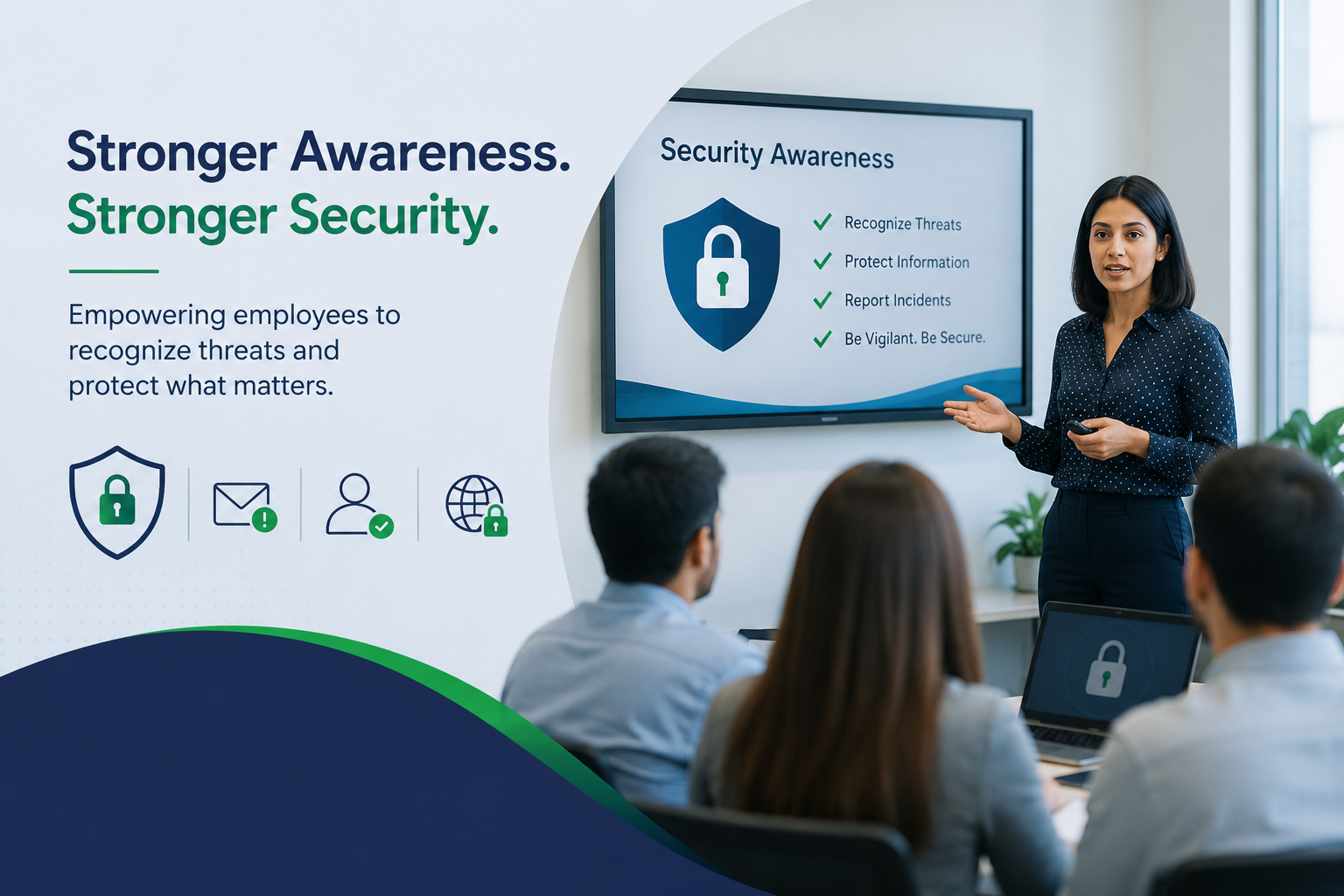
Human error contributes to a significant share of cybersecurity breaches — many of which a more informed workforce could have prevented. Security awareness training addresses that gap by giving employees the knowledge and habits to recognize threats before they reach your systems.
What Is Security Awareness Training?
Security awareness training is a structured program that educates employees on identifying, avoiding, and reporting cybersecurity threats. It covers topics such as phishing, social engineering, password hygiene, data handling, and acceptable use of company systems.
The objective is not to produce security specialists. It is to ensure employees understand threat patterns well enough to avoid common mistakes. Clicking a malicious link, sharing credentials over an unsecured channel, or dismissing a suspicious login alert without reporting it are all mistakes that have occurred enough that we have a plan of defense against them.
Why Human Error Remains a Persistent Risk Factor
Technology controls such as firewalls, endpoint detection, and access management are necessary but insufficient on their own. Attackers increasingly target people rather than systems because human behavior is harder to patch than software.
Phishing remains one of the most prevalent attack vectors. A well-crafted phishing email can mimic a trusted sender convincingly enough to deceive experienced professionals who haven’t been trained to scrutinize requests carefully. Vishing (voice phishing), smishing (SMS-based attacks), and pretexting add further complexity. Employees without consistent training are unlikely to recognize these tactics until damage has occurred.
Security awareness training reduces the probability that a single employee mistake results in a breach. It moves the workforce from a passive vulnerability to an informed line of defense.
Key Components of an Effective Program
A security awareness program delivers most of its value through consistency, relevance, and reinforcement. Programs that produce measurable behavior change typically include the following:
- Phishing simulations: Controlled internal phishing tests measure how employees respond to simulated attacks. Results identify which teams or individuals need additional coaching and whether awareness improves over time.
- Role-based training: Employees in finance, HR, or IT face different threat profiles than general staff. Training mapped to specific roles is more applicable and more likely to be retained.
- Ongoing refreshers: Annual training alone does not sustain behavioral change. Organizations that run quarterly modules, short video updates, or monthly security tips see better long-term compliance than those relying on a single annual session.
- Clear reporting pathways: Employees need to know exactly how to report suspicious activity and feel confident doing so without fear of reprisal. A low-friction reporting process increases the likelihood that potential incidents get flagged before they cause harm.
Regulatory and Compliance Implications
Many industries operate under frameworks that require or strongly recommend security awareness training. HIPAA, PCI DSS, SOC 2, ISO 27001, and NIST guidelines each address employee security competency to varying degrees.
Organizations that cannot demonstrate a formal training program face elevated risk during audits and, in some cases, regulatory penalties following a breach. Documented training records also carry weight in legal proceedings where due diligence is in question.
The Business Case Beyond Compliance
Security awareness training is not only a compliance exercise. The financial consequences of a data breach, such as incident response costs, regulatory fines, customer notification, reputational damage, and operational disruption routinely exceed the cost of running a consistent training program.
Employees who understand security protocols handle sensitive customer data more carefully, which supports customer trust and reduces accidental data exposure. In industries such as financial services, healthcare, and telecommunications, where customer data is both highly sensitive and frequently targeted, this translates into a measurable operational advantage.
Building a Security-Aware Culture
The most durable outcome of security awareness training is a shift in organizational culture. When employees treat security as a shared responsibility rather than an IT department concern, the overall security posture improves beyond what technical controls alone can achieve.
Leadership participation is a direct factor. When executives and managers visibly complete training, comply with security policies, and reinforce reporting norms, employees follow. Culture-driven security programs do not depend on enforcement alone, they rely on a workforce that understands why the protocols exist.
Security incidents are a business risk, not just a technical one. Auditing your current employee training program against the frameworks your industry requires is a practical first step toward closing the gaps that technical controls cannot address.
Etech Global Services brings 25 years of operational experience managing interactions across regulated industries, with a zero data breach record across that history. Our contact center programs are built around rigorous compliance, agent accountability, and data security standards.
Connect with our team today to discuss how our approach to training, quality, and compliance supports secure contact center operations. Learn more about Etech Global Services contact center services.

Ronnie Mize is the Chief Security Officer of Information Technology for Etech Technical Services. Ronnie has been in the technology sector for 20 years and has held technology leadership roles with Microtech America, The Berry Company (a subsidiary of Bellsouth) and Etech. His entrepreneurial background includes extensive experience in technology development and deployment as well as implementation of business processes and defined methodology.
