July 23, 2026
AI + Humans: The New Power Duo Driving Call Center Excellence
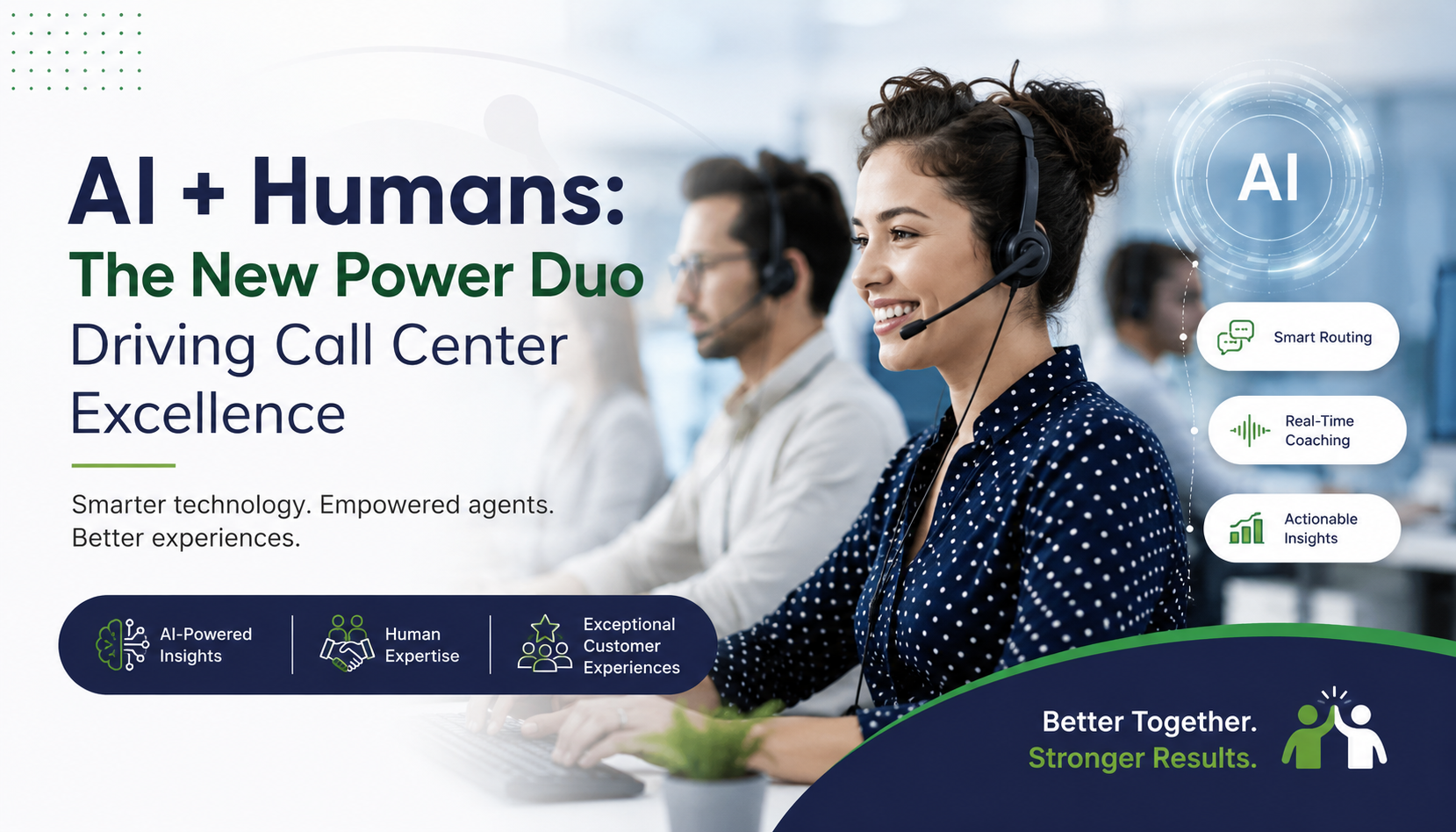
Call centers that perform consistently well share one defining characteristic: they treat AI as a tool that makes human agents more effective, not as a substitute for them. The organizations seeing measurable gains in first call resolution, customer satisfaction, and agent retention are those that have built workflows where technology and people reinforce each other, each handling the work it does best.
What AI Handles in the Call Center
AI manages the tasks that slow agents down without contributing directly to customer outcomes. Automated call logging, data entry, and routine follow-up work can consume a significant portion of an agent’s shift. AI systems take on these functions reliably and at scale, returning that time to agents for interactions that require judgment.
Smart routing systems reduce unnecessary transfers by matching customer inquiries to agents based on skill sets and interaction history. This direct match lowers average handle time and improves first call resolution, a metric with measurable downstream effects on both cost per contact and customer satisfaction scores.
How Real-Time AI Coaching Improves Agent Performance
During live interactions, AI-assisted coaching tools surface relevant knowledge base articles, prior case data, and suggested next steps without requiring agents to search manually. Agents maintain conversation flow while accessing the information they need, which reduces hold time and keeps average handle time in check.
Speech analytics adds a second layer of support. When a caller shows signs of frustration, the system alerts the agent to adjust tone or escalate the interaction. This real-time guidance supports consistent service quality across all agents, including newer team members who are still building experience.
Predictive Analytics and Proactive Customer Service
AI’s ability to identify patterns in historical interaction data creates opportunities for proactive outreach. If data shows that customers who purchased a specific product tend to call about setup issues within a defined window, the system can trigger outreach before the call arrives, turning a reactive queue into a proactive service touchpoint.
Predictive models also support workforce planning. Accurate call volume forecasting allows supervisors to staff for actual demand rather than reacting to it, keeping agent occupancy rates within the 65–85% range where productivity is high and burnout risk stays manageable.
The Role Humans Play in Call Center Excellence
AI improves the conditions for effective work, but the quality of a customer interaction still depends on the agent. Complex problem-solving, empathy, and nuanced judgment are not outcomes that automation produces reliably. Customers calling about sensitive billing situations, service failures, or escalated complaints need an agent who can listen, adapt, and respond with contextual understanding.
The contact centers that achieve the strongest results are those where AI reduces operational friction, long hold times, repetitive data entry, inconsistent routing, so agents can focus on the interactions where their judgment and interpersonal skills determine the outcome.
Building a Call Center Model That Combines Both
The practical model for call center excellence is not AI-first or human-first. It is a structured workflow where AI handles data processing, routing, and real-time information delivery, while agents manage customer relationships that require human judgment. The two functions are not in competition, they cover different parts of the same interaction.
Organizations that build this model deliberately, with clear handoff points between automated and human-handled tasks, see improvements across the metrics that matter most: first call resolution, customer satisfaction scores, average handle time, and agent retention.
Ready to build a contact center operation where AI and human agents work effectively together? Etech Global Services brings 25 years of contact center expertise and AI-assisted solutions that are designed to improve agent performance and customer outcomes.
Schedule a consultation today and learn how the right combination of technology and human expertise can drive consistent, measurable improvements across your contact center.

Patrick Reynolds serves as Etech’s Senior Vice President of Business Development & Client Solutions. Since joining Etech in 2000, Patrick has held multiple leadership roles and has been instrumental in building and scaling Etech’s global operations. In 2005, he played a key role in training the first outbound and inbound teams at Etech’s Gandhinagar, India facility—laying the foundation for what has now grown to a team of 600+ professionals across sales and support functions. Patrick is known for fostering meaningful client relationships and delivering tailored, results-driven solutions. In his current role, he leads strategic business development efforts and partners closely with clients to unlock new growth opportunities and strengthen long-term trust.
