October 1, 2026
Call center software vs. managed BPO services: which one actually fixes the CX problem?
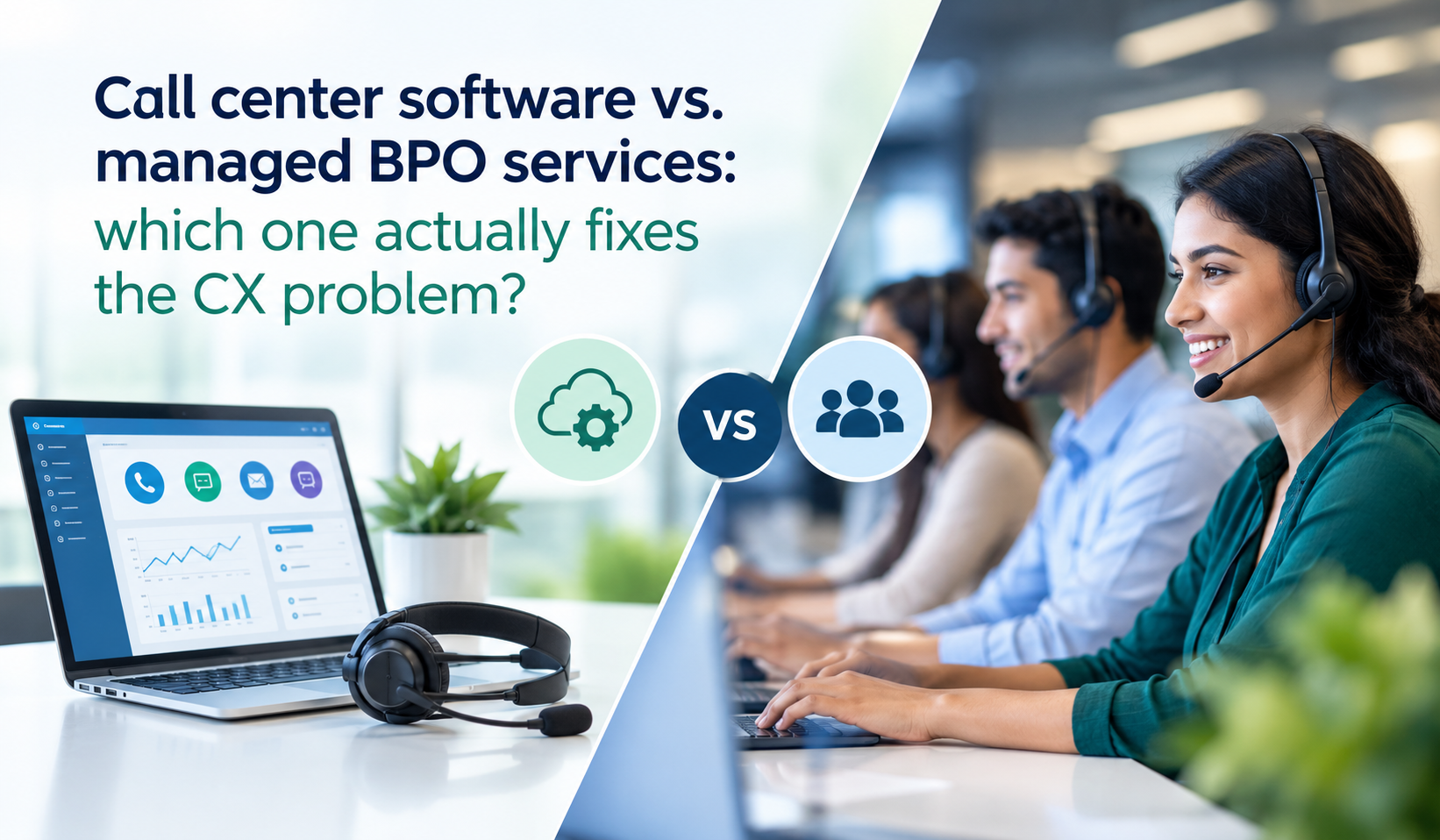
When customer experience scores slip, the instinct is to reach for a fix: new call center software, or a new outsourcing partner. Both assumptions skip a step. The real question is not whether to invest in technology or hire a business process outsourcing partner. It is whether the CX problem originates in the technology itself, in the people and processes running on top of it, or in both at once.
What does call center software actually solve?
Call center software, including CCaaS platforms, gives organizations the infrastructure to route interactions, unify channels, and capture performance data in real time. It automates workflows and surfaces analytics that were previously invisible. What it does not do is guarantee that agents apply that infrastructure well, or that staffing and coaching keep pace with demand.
Modern platforms unify omnichannel routing, agent workflows, and customer data into one interface, so agents move between voice, chat, and email without losing context. Dashboards and interaction analytics turn call volume, handle time, and sentiment into numbers leadership can act on, and many platforms now layer AI-assisted transcription on top. None of this replaces the training and management discipline that determine how agents actually use it.
What do managed BPO services actually solve?
Managed BPO services take direct responsibility for the people and processes that determine whether an interaction actually resolves well. A BPO partner recruits and trains agents, manages workforce scheduling, runs quality assurance, and owns the operational performance of the account, not just the technology behind it.
Beyond staffing, an experienced BPO partner manages the full operating cycle: recruiting to the right profile, structured onboarding, workforce management matched to forecasted volume, and quality assurance that catches coaching opportunities before they show up in survey scores. That oversight is what turns a support function into a repeatable operation, with someone accountable for the outcome of the account, not only for keeping the lines staffed. Industry benchmarks commonly place annual contact center attrition between 30 and 45 percent, higher still for offshore operations, and consistent execution is what keeps that turnover from surfacing in the customer experience.
Call center software vs. managed BPO services
The differences become clearer side by side.
| Area | Call Center Software | Managed BPO Services |
| Technology | Provides the platform | Runs daily operations on it |
| People | Not included | Recruits and manages agents |
| Processes | Enables automation | Builds and improves workflows |
| Staffing | Not addressed | Owns hiring and scheduling |
| Training | Supplies training tools | Designs and delivers training |
| Quality management | Supplies monitoring tools | Runs the QA program |
| Customer interactions | Enables and routes them | Executes and resolves them |
| Analytics | Generates data and dashboards | Turns data into coaching |
| Scalability | Scales licenses | Scales staffing and management |
| Operational accountability | Vendor supports the platform | Partner owns the outcome |
| Best for | Strong teams needing better tools | Teams needing execution capacity |
Missing data, disconnected channels, or a lack of visibility point to a technology gap that call center software and CCaaS platforms close directly. High attrition, inconsistent quality scores, or agents who have tools but not the coaching to use them well point to an operational gap that a managed BPO partner owns instead, and many organizations find both gaps at once.
Choosing the right model: software, BPO, or both
Call center software tends to be the stronger investment when the operating team is already capable, but outdated infrastructure holds it back. Organizations with mature processes and internal expertise, where disconnected channels or manual reporting are the main constraint, typically get the most value from a platform upgrade on its own.
Managed BPO services tend to be the stronger investment when the core problem is staffing, consistency, or operational expertise rather than the platform itself. Organizations facing high agent attrition, inconsistent quality, or a need to scale support without building an entire operations function internally typically see faster improvement from a managed partner.
For many organizations, combining both approaches outperforms choosing one alone. A technology-enabled BPO approach pairs a modern CCaaS platform with a partner that runs the operation on top of it: the platform supplies automation and analytics, and the partner supplies recruiting, training, and the day-to-day accountability that turns that infrastructure into consistent outcomes.
Five questions help narrow the decision: whether the biggest problem is technology or execution, whether internal expertise exists to manage the operation day to day, whether staffing and attrition are affecting outcomes, whether the organization can consistently measure performance today, and whether the real need is better technology, better execution, or both. The answers point toward a software investment, a managed BPO partnership, or a technology-enabled model that combines them.
The question that opened this piece does not have one universal answer. Call center software is not automatically the fix, and neither is outsourcing on its own; the organizations that resolve CX problems fastest diagnose the root cause first, then select the operating model that actually addresses it, whether that means better technology, stronger execution, or both together.
Etech Global Services has spent 25 years running technology-enabled BPO programs that pair CCaaS platforms with the staffing, training, and quality management that execution requires, across 200 million+ interactions per year and seven global sites spanning the US, Jamaica, and India. Organizations working through this decision can contact Etech Global Services to walk through where their own CX gap actually sits before committing to a new software or BPO agreement.
Frequently asked questions
What is call center software?
It is a platform that manages customer interactions across channels such as voice, chat, and email, typically including routing, workflow automation, and reporting. Providers often market cloud-based versions as CCaaS, or contact center as a service.
What is the difference between call center software and BPO?
Call center software provides the technology used to manage interactions. Managed BPO services provide the people, staffing, training, and quality management that determine how well those interactions are actually handled.
Is CCaaS the same as BPO?
No. CCaaS is a cloud-based technology platform. BPO is an operational service in which a partner organization runs some or all of the customer support function, often using a CCaaS platform to do it.
Is BPO better than using call center software alone?
Neither is inherently better. BPO tends to have more impact when the CX problem is rooted in staffing, training, or execution. Software tends to have more impact when the problem is rooted in outdated or disconnected technology.
Can BPO services use call center software?
Yes. Most managed BPO partners operate on top of call center software or a CCaaS platform, combining the technology with staffing, training, and quality management in a model the industry often calls technology-enabled BPO.

Gurudatt Medtia serves as Executive Vice President, bringing transformational leadership to Etech’s global operations. In this expanded role, Guru is responsible for driving strategic initiatives, market expansion, and cross-functional leadership across the organization. He plays a key role in strengthening Etech’s people-first culture and ensuring seamless collaboration across departments. His ability to foster lasting relationships, paired with his commitment to operational excellence, has helped position Etech as a trusted partner and employer of choice.
