October 23, 2026
CCaaS vs. BPO: How to Choose the Right Contact Center Model for Your Business
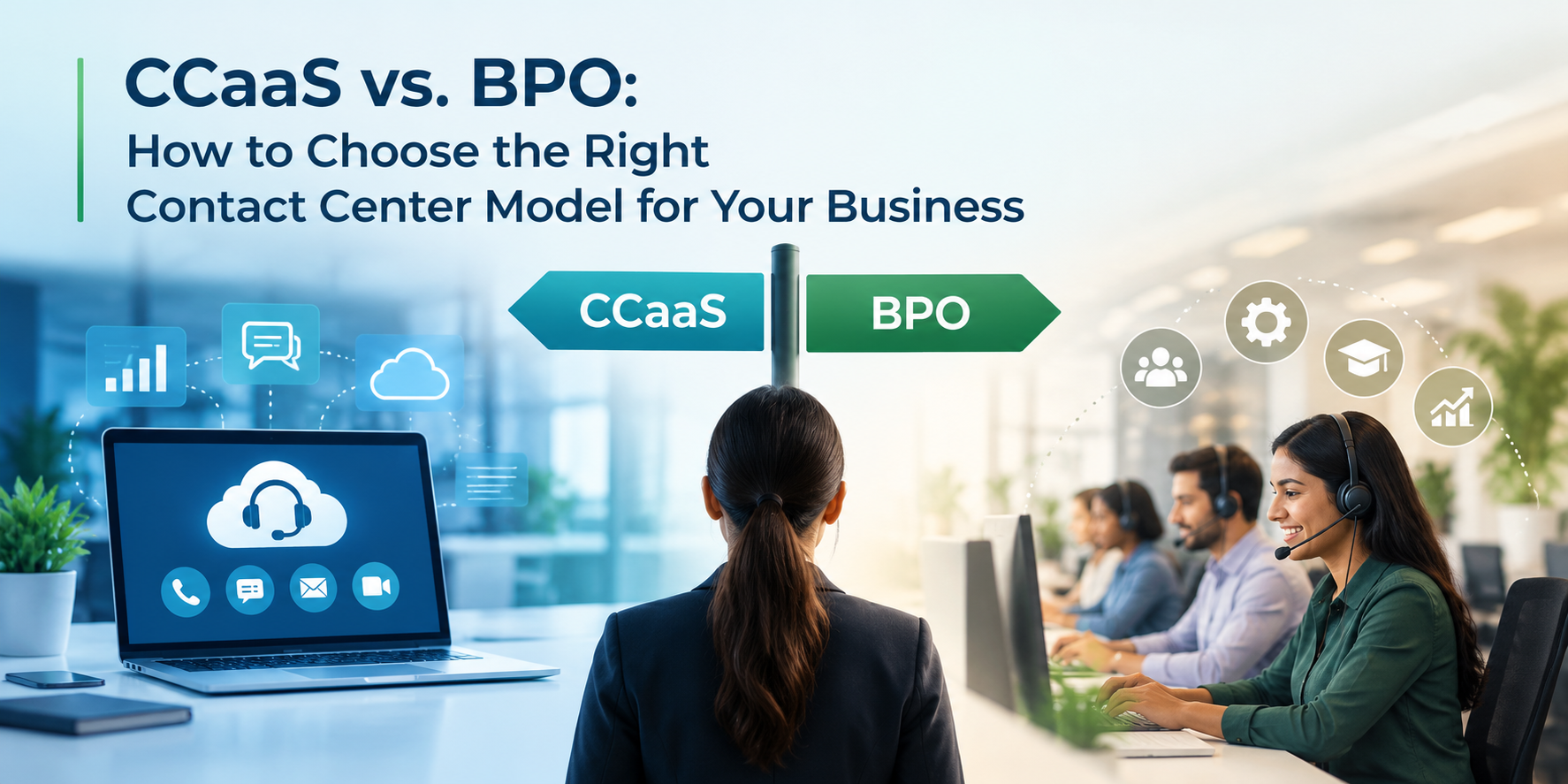
Companies modernizing customer service usually run into two decisions at once: which technology should power the contact center, and who should operate it. These get discussed as if they’re one choice, but they aren’t, and answering one does not answer the other.
CCaaS, contact center as a service, is a technology decision. It determines what platform routes calls, chats, and other interactions. BPO, business process outsourcing, is an operating decision. It determines who staffs, manages, and runs the contact center day to day. Understanding this distinction is the starting point for choosing between CCaaS, BPO, or a combination of the two.
What Is CCaaS?
CCaaS is a cloud-based contact center technology model. A provider hosts the routing, telephony, and interaction management software, and the buying organization accesses it through a subscription instead of building and maintaining the infrastructure itself.
Typical CCaaS capabilities include omnichannel routing across voice, chat, and email, workforce management tools, integrations with CRM and other business systems, and built-in reporting and analytics. Cloud contact center platforms generally deploy faster than legacy on-premise systems and adjust capacity as volume changes.
CCaaS addresses infrastructure, not operations. Adopting a platform still requires an organization to recruit, train, schedule, coach, and manage the agents who use it. Staffing and quality management remain the buyer’s responsibility unless the platform is paired with an operating partner.
What Is BPO in the Contact Center Industry?
BPO stands for business process outsourcing. In the contact center industry, it means a third-party provider manages some or all of the operational work behind customer service: staffing, training, quality management, scheduling, coaching, and day-to-day performance management.
A BPO provider typically brings its own workforce, operational processes, and management infrastructure. Some providers use their own contact center technology; others operate on the technology a client already has, including a CCaaS platform.
BPO is an operational and service delivery model, not a technology product. Its value comes from the people, processes, and management discipline behind each interaction, not from a piece of software.
CCaaS vs. BPO: What’s the Difference?
The table below breaks down where the two models diverge.
| Factor | CCaaS | BPO |
| Primary purpose | Technology platform | Outsourced operations |
| Workforce | Managed internally by the buyer | Managed by the BPO provider |
| Technology | Cloud-based platform, buyer-owned subscription | Provider may use client technology, its own platform, or a mix |
| Staffing | Buyer’s responsibility | BPO provider’s responsibility |
| Training | Buyer’s responsibility | Typically the BPO provider’s responsibility |
| Scalability | Technology capacity scales | Technology and workforce both scale |
| Operational control | Higher internal control | Shared or largely outsourced control |
| Implementation | Software setup and integration | Operational transition and knowledge transfer |
| Best suited for | Organizations building and running their own contact center | Organizations seeking operational expertise, staffing capacity, or scale |
CCaaS vs. BPO: Which One Is Right for Your Business?
The choice isn’t always either/or. Some organizations need a technology upgrade and already have the staffing and management capability to run it. Others need operational capacity and expertise more than a new platform. Many need both: a modern technology layer paired with an experienced team to operate it.
When Should You Choose CCaaS?
CCaaS tends to fit organizations that:
- Want to retain direct operational control over their contact center
- Already have an experienced, stable workforce in place
- Have internal IT and operations resources to manage implementation and ongoing administration
- Are modernizing legacy, on-premise infrastructure and need cloud flexibility
- Can commit the internal time required for staffing, training, and quality management on an ongoing basis
When Should You Choose a BPO?
A BPO model tends to fit organizations that:
- Need to scale contact center capacity quickly, including seasonal or event-driven volume
- Are struggling to hire, train, or retain contact center staff
- Want to reduce the day-to-day operational complexity of running a contact center
- Don’t consider contact center management a core competency
- Are entering new markets or supporting multiple locations and need an established operating partner
- Want a more variable cost structure tied to volume rather than fixed headcount
- Want an experienced partner managing quality, coaching, and performance
Can CCaaS and BPO Work Together?
CCaaS and BPO solve different problems, and they aren’t mutually exclusive. CCaaS provides the technology infrastructure. BPO provides the people, processes, and operational expertise to run the customer experience on top of it.
An organization can adopt a cloud contact center platform as its technology backbone and outsource the operational work, staffing, quality management, coaching, and day-to-day performance, to an experienced BPO. This lets a business modernize its technology without also having to build an internal operations function from scratch.
Etech Global Services works this way with clients: as a BPO and managed contact center services partner that operates customer experience programs on the technology environment a client already has, including CCaaS platforms, rather than requiring a proprietary system. The role is operational, not a software licensing arrangement.
7 Factors to Consider Before Choosing a Contact Center Model
- Business objectives. Is the underlying problem a technology gap, an operating capacity gap, or both?
- Required level of operational control. Do you need to manage staffing and quality directly, or is a managed partner acceptable?
- Existing workforce capabilities. Do you have a trained, stable team, or are you starting from zero?
- Technology maturity. Do you already have a modern platform, or does infrastructure need to be addressed first?
- Scalability requirements. Is volume steady, seasonal, or growing quickly?
- Total cost of ownership. Compare platform subscription and internal headcount costs against a BPO’s all-in operating cost.
- Customer experience requirements. What channels, languages, hours, and compliance requirements does the program need to support?
The Bottom Line: CCaaS vs. BPO
CCaaS answers one question: what technology will power the contact center? BPO answers a different one: who will operate it? Many organizations get more value from combining the two than from choosing only one.
Etech Global Services works with businesses as a BPO and managed contact center services partner, helping organizations manage customer service operations while making effective use of the contact center technology already in place. Before choosing a model, map your current contact center gap: is it a technology gap, an operating capacity gap, or both?
Frequently Asked Questions
What is the difference between CCaaS and BPO?
CCaaS is a cloud-based technology platform for contact center routing and interaction management. BPO is an outsourced operating model in which a third-party provider manages contact center staffing, training, quality, and day-to-day performance. CCaaS addresses the technology question; BPO addresses who runs the operation.
Is CCaaS a BPO?
No. CCaaS is a technology product delivered through a cloud subscription. A BPO is a service provider that manages contact center operations, often with its own workforce and processes. Some BPO providers use CCaaS platforms as part of their technology stack, but the two aren’t the same thing.
Is CCaaS better than outsourcing?
Neither is inherently better. CCaaS solves a technology problem: it gives an organization a modern platform to run on. Outsourcing to a BPO solves an operating problem: it provides staffing, management, and expertise. Which is better depends on whether the real gap is technology, operational capacity, or both.
Can a company use CCaaS and BPO together?
Yes. A company can adopt a CCaaS platform for its technology infrastructure and outsource operational work, staffing, quality management, and day-to-day performance, to a BPO provider. This combination is common among organizations that want modern technology without building an internal operations function to run it.
Which is more cost-effective, CCaaS or BPO?
It depends on the organization’s starting point. CCaaS shifts technology costs from capital investment to a recurring subscription but leaves staffing costs unchanged. BPO shifts staffing to a variable, volume-based cost that includes a management fee. Comparing total cost of ownership, not just the headline price, gives the clearer answer.
When should a company choose contact center outsourcing?
Contact center outsourcing tends to make sense when a company needs to scale quickly, is struggling to hire or retain staff, wants to reduce operational complexity, or doesn’t consider contact center management a core competency. It’s also common when entering new markets or supporting multiple locations.
What should businesses consider when choosing between CCaaS and BPO?
Businesses should weigh their underlying business objective, the level of operational control they want to retain, their existing workforce capability, technology maturity, scalability needs, total cost of ownership, and the customer experience requirements of the program before deciding between CCaaS, BPO, or a combination of both.
Before choosing a model, map your current contact center gap against both questions: what your technology can do, and who is best positioned to run it day to day. If the gap turns out to be operational rather than technical, Etech Global Services can help you think through what a managed contact center partnership would look like for your team.

Amit Kachhawa is Senior Vice President, Corporate Strategy and Enterprise Execution at Etech Global Services. He leads strategy and execution governance across Etech and its group companies, with executive oversight of finance and enterprise-wide delivery. A founding member of Etech India with 23 years inside the business, Amit writes on strategic outsourcing, operational execution, and the decisions that separate companies that plan from companies that deliver.
