October 30, 2026
How to Choose a Contact Center Outsourcing Partner: A BPO Evaluation Framework for Operations Leaders
The short version
- Decide what you’re buying before you meet a vendor. Outcomes like resolution, quality, and cost per resolved contact matter more than seats and hours.
- Pick the delivery model first, then the partner. Onshore, nearshore, and offshore fit different work, and a single site is a single point of failure.
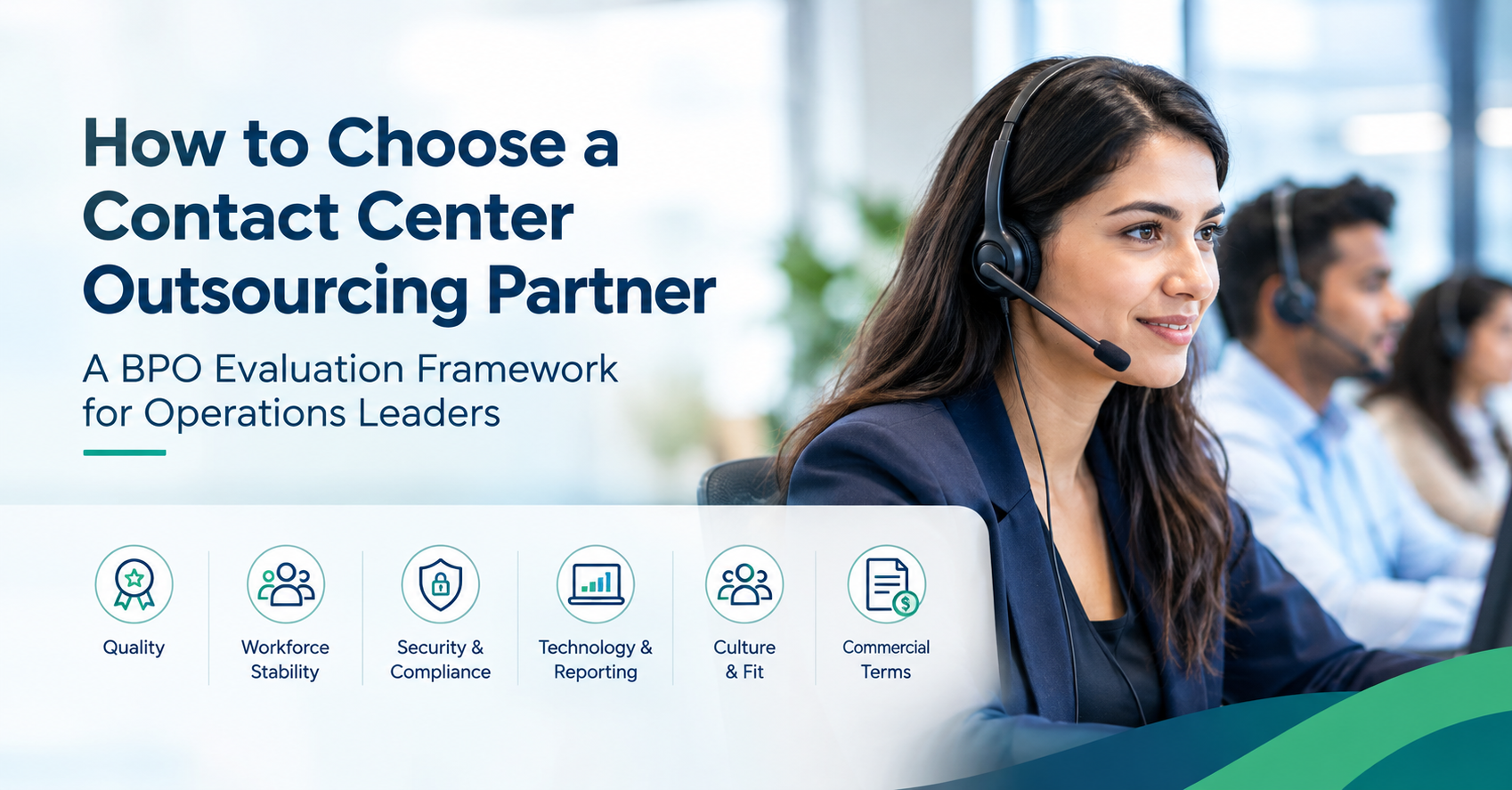
- Score six things before you see a demo: quality evidence, workforce stability, security and compliance, technology and reporting, culture on the floor, and commercial terms.
- Ask for numbers, not adjectives. Then phase the launch, baseline your current performance, and name one owner.
I walked into a client site a few years back. Large telecommunications operation, around 1,200 agents across two floors. Their quality team was eight people working full time on call evaluations. When I asked what percentage of calls they were reviewing, the answer was 4%. They were proud of it. That meant 96% of their customer conversations never got heard by anyone.
I’ve thought about that room every time someone asks me how to choose an outsourcing partner. Buyers usually lead with price, location, and logos. A good pitch deck answers all three in the first ten minutes. What a pitch deck can’t answer is what happens on the floor next Monday, and whether anyone will tell you when it goes wrong.
This guide gives operations leaders a framework for choosing a contact center outsourcing partner, whether you call it a BPO, a call center vendor, or an extension of your own team. It covers what you’re buying, which delivery model fits, six criteria to score, the questions that separate operators from vendors, the red flags, and the first 90 days. I’m the CRO of an outsourcer, so I’ll say where my side of the table gets this wrong.
Start With the Work You’re Handing Over, Not the Vendor List
Most RFPs open with seats, hours, and channels. Those are inputs. What you’re actually buying is an outcome: contacts resolved, quality held, customers who stay, and a cost per resolved contact you can defend. Write those down first, with the volumes, contact types, languages, systems, and compliance obligations behind them. Then write down the two or three misses that would make you fire a partner. You’ll evaluate everyone against that page.
Then look at the work itself before you hand it to anyone. Analysis at one client showed that 22 percent of a month’s contacts were customers asking for a receipt. The receipt already existed online. Reaching it took nine clicks. That is not a staffing problem. It’s a digital experience problem, and any partner who takes that work will staff for a call you could have deleted. Fix what you can before you outsource, and ask every partner which of your contacts they would eliminate. The good ones will have an answer. The rest will quote you a headcount.
Our post on the principles for outsourcing your customer service covers the basics, and our guide to the factors to consider when outsourcing your contact center walks through the decision from the buyer’s side.
Onshore, Nearshore, or Offshore: Pick the Delivery Model Before the Partner
Onshore, nearshore, and offshore aren’t ranked tiers. They fit different work. Complex, emotional, or high value interactions tend to belong close to the customer, in the same language and culture. Routine, high volume work often suits a larger talent pool and a different cost structure. Most programs end up with a mix, and the mix is the decision.
Cost per seat is the wrong criterion on its own. The better question is where the human in the loop adds the most value, and what happens when one location goes down. A single delivery location is a single point of failure. Ask every partner how they would shift your volume if a site lost power, connectivity, or staff.
Voice quality is not negotiable. One call with echo or lag costs you the customer’s trust, so ask how the partner tests it by site. And if your customers or regulators expect US based support, get that commitment in writing.
Etech Global Services delivers from seven centers in three countries: four in Texas, one in Montego Bay, Jamaica, and two in Gujarat, India. English and Spanish delivery runs from onshore through offshore. Our global delivery page maps the footprint, and our guides to choosing between India and Jamaica and to the India offshore center show how the tradeoffs play out.
Six Criteria to Score Every BPO Partner Before the Demo
Decide the weights before you sit through a demo, or the demo will decide them for you. These are the six I’d score.
- Quality evidence. Ask what percentage of interactions the partner reviews and how long it takes a call to turn into a coaching conversation. Legacy programs review 2 to 5% by hand, and the feedback lag runs up to 6 weeks. Ask for the number, not the adjective. Then ask about accuracy, because coverage is not accuracy, and a number in a contract is a number someone has to defend. Etech Global Services analyzes 100% of interactions with https://www.etechgs.com/etslabs/qeval/, and we hold 94% or better classification accuracy as a contractual SLA.
- Workforce stability. Ask for the tenure of the people who would staff your program, not the company average. Tenure is the cleaner comparison, because attrition comes in monthly and annual versions that don’t compare. Industry average tenure runs 13 to 15 months. Average tenure at Etech Global Services runs 6.3 years, and agents train for six weeks before they take a call. I’ll quote our monthly attrition, under 5%, but only so you can ask every other partner for the same definition.
- Security and compliance. Ask for reports, not badges. SOC 2 Type II, PCI DSS, HIPAA, and GDPR each cover different ground, so match them to your data. Etech Global Services is SOC 2 Type II and SOC 3 certified, aligned to ISO 27001:2022, and has operated since 2003 with zero breaches across monitored systems and facilities. Our Trust Center and our post on data security protocols go deeper. Talk to your security team early, not after you’ve signed.
- Technology and reporting. Ask who builds the tools your agents will use. We build ours, and I’m biased. When we own the code, we close a gap in weeks instead of filing a request into a vendor roadmap. That’s a real advantage and a real cost, and not every partner should build. Whatever the answer, ask about integration with your systems, because integration is not optional. Then ask which three reports you would use to make decisions. I reviewed a 47 page report with a client last year, and the operations director told me she used about three of the metrics.
- Culture on the floor. Meet the team lead who would run your program, and ask how supervisors get evaluated. If it’s only metrics, expect pressure. If agent development counts, expect people who stay. Half of our executives started as agents, and every leadership role posts internally before we recruit outside. Etech began in 2003 when our founders bought a closing contact center in Nacogdoches, Texas and kept roughly 400 jobs. That origin shapes how we treat people. Servant leadership isn’t soft. It pairs rigorous measurement with a manageable number of coached behaviors.
- Commercial terms and exit. Ask for the full invoice before the contract. Many rate cards split supervision, QA, training, technology per seat, telecom, compliance, overtime, and management into separate charges, and the total tells a different story than the headline rate. We bill one all inclusive rate, with every expense approved before work begins. Then ask how you would leave. A partner who can’t describe your exit hasn’t thought about how you’d stay. On QEval we offer a 60 day exit with no penalty, and I’d ask any partner for the equivalent.
Put the six on one page, and score every partner against the same rows.
| Criterion | What to ask for | Evidence that counts |
| Quality evidence | Review percentage, feedback lag, accuracy | A number in the contract and scored interactions with the reasoning attached |
| Workforce stability | Tenure and attrition for your program, with definitions | Tenure by team, training length, supervisor span |
| Security and compliance | Audit reports matched to your data | Current reports, breach history, a call with your security team |
| Technology and reporting | Who builds the tools, integrations, the three reports you’d use | A demo on your data and a named integration plan |
| Culture on the floor | How supervisors get evaluated, how people get promoted | A conversation with the team lead who would run your program |
| Commercial terms | The full invoice, every fee category, exit terms | A sample invoice and written exit terms |
Ask Questions a Vendor Can’t Answer With an Adjective
These questions work in an RFP, on a site visit, and on a reference call. Each one has a number, a name, or a document as its answer.
- What percentage of interactions do you review, and what happens within a week of a bad one? A partner who reviews 4% and is proud of it has told you something. So has a partner who can’t describe the next step.
- What’s the average tenure of the agents who would staff my program, and how do you define attrition? Get the definition in writing. Monthly and annual figures look similar and mean different things.
- Show me the last time you told a client something they didn’t want to hear. That willingness is what makes every other report believable. If no example comes to mind, you’ve learned how reporting will go.
- Who owns my program on Monday, by name? Ownership must be unmistakable. A title on an org chart doesn’t count.
- Where does your technology fail, and what do you do when it does? Transcription that holds at 92% in a demo can drop to 78% on real, busy inbound. A partner who has run production knows that gap and will tell you about it.
- Can I speak with a client who left? Logos tell you who signed. The clients who left tell you why it ended.
Red Flags Show Up Before the Contract
Most of them appear in the sales process, long before anyone signs.
- The deck has no operator in the room. If the sales team can’t answer a question about the floor, nobody who runs it is accountable to you. A vendor sells you the platform and moves on to the next sale. An operator has to run it on a live floor on Monday.
- Adjectives instead of numbers. Leading and trusted aren’t metrics. Ask for the figure and the definition behind it.
- No weaknesses. A partner who can’t name anything they do badly isn’t being honest with you. Ask where they would tell you not to use them.
- A fee structure that needs a diagram. If you can’t follow the invoice, you can’t audit it. Expect surprises.
- No pilot. A partner who won’t prove it on a small scope is asking you to carry the risk of full deployment.
- Logos without references. A client list says who signed. It doesn’t say who stayed.
The First 90 Days Decide Whether You Chose Well
Selection is the simpler part. The first 90 days decide whether it worked. Phase the launch instead of going big bang, involve agents from the first week, and train by role. I use an 80/20 rule for AI implementations, 20 percent technology and 80 percent change management, and a program transition behaves the same way. Crawl, walk, run. It isn’t optional.
- Before launch, baseline. Record your current numbers before the partner touches anything, or you’ll argue about results for a year. Every improvement I’ve documented started with a baseline.
- Days 1 to 30, run a small scope. Start with a contained set of contacts, review them weekly, and calibrate quality scoring together. People validate the standard, and the data shows where evaluators drift.
- Days 31 to 60, expand and coach. Add volume in stages, coach a small number of behaviors, and fix the process causes in parallel. Coaching can’t offset a broken knowledge article.
- Days 61 to 90, review and reset. Compare against the baseline, retire the measures nobody uses, and agree on targets for the next quarter.
Ask for the implementation plan in writing, with dates and names. Our typical deployment runs 30 to 90 days, depending on scope.
Hold the Partner to the Standard You’d Hold Your Own Team To
Governance is a cadence, not a document. Review operations weekly, outcomes monthly, and strategy quarterly. Use balanced measures across quality, efficiency, customer outcomes, and people, because any single metric in isolation misleads you. Give every miss an owner and a date. Not the team. A person. With a deadline.
Then own your side. Slow approvals, unclear policy, and stale knowledge content cause a share of every partner’s misses, and a partner who tells you so is doing the job. Share the data both ways. When both sides can see 100% of the interactions, the argument moves from whose numbers to what the numbers say. Our posts on managing vendor relationships, effective vendor management, and vendor management for contact centers cover the cadence in more detail.
Where Outsourcing Doesn’t Work
Not every program should move. If you can’t define the work, a partner can’t deliver it. If your processes are broken and you’re hoping a partner will fix them, you’ll pay someone else to run the same problem. If the only goal is cost, know the limit going in. Cost reduction has a ceiling. Experience improvement doesn’t. Some interactions, like emotionally complex service and retention conversations, may belong with your own people, and a partner who says everything should move is selling. Our post on how to reduce costs and improve CX through outsourcing covers where the economics hold.
Frequently Asked Questions
How do I choose a contact center or call center outsourcing partner?
Define the outcomes first and pick the delivery model. Then score partners on six things: quality evidence, workforce stability, security and compliance, technology and reporting, culture on the floor, and commercial terms. Ask for numbers and documents, run a pilot, and baseline your current performance before launch.
What should a contact center outsourcing RFP include?
The work: volumes, contact types, channels, languages, hours, systems, and compliance obligations. Then the outcomes you will hold the partner to, the questions in this guide, a full sample invoice, and the exit terms. Ask partners to answer with numbers and attach evidence.
What is the difference between onshore, nearshore, and offshore contact centers?
The difference is location relative to your customers, and it affects language, time zone, talent pool, cost structure, and risk. Complex interactions often fit closer to the customer. Routine volume often fits a larger talent pool. Most programs mix models.
How much does contact center outsourcing cost?
It depends on the delivery model, volume, complexity, and what the rate includes. Compare partners on the full invoice, not the headline rate, and ask whether supervision, QA, training, technology, telecom, and compliance sit inside it. Etech Global Services bills one all inclusive rate.
How long does it take to transition a program to an outsourcing partner?
It depends on scope and complexity. Ask for a written plan with dates, owners, and a phased launch. Our typical deployment runs 30 to 90 days.
What is a BPO, and is it the same as a contact center outsourcing partner?
A BPO, or business process outsourcing provider, runs a business function on your behalf. In customer experience, that usually means customer service, technical support, inside sales, or back office work. A contact center outsourcing partner is a BPO that specializes in customer interactions across voice, chat, email, and social. The label matters less than the evidence, so ask every BPO the same questions in this guide.
Vendors will move on to the next sale. You still own the operation.
If you’re evaluating partners, ask us these questions first. Tell us what you’re trying to solve, and we’ll tell you whether Etech Global Services is the right fit, including when it isn’t. You can request a proposal or start with our CX assessment.

Jim Iyoob is the Chief Revenue Officer for Etech Global Services and President of ETSLabs. He has responsibility for Etech’s Strategy, Marketing, Business Development, Operational Excellence, and SaaS Product Development across all Etech’s existing lines of business – Etech, Etech Insights, ETSLabs & Etech Social Media Solutions. He is passionate, driven, and an energetic business leader with a strong desire to remain ahead of the curve in outsourcing solutions and service delivery.
