September 16, 2026
Essential quality checks for implementing AI-driven contact center analytics
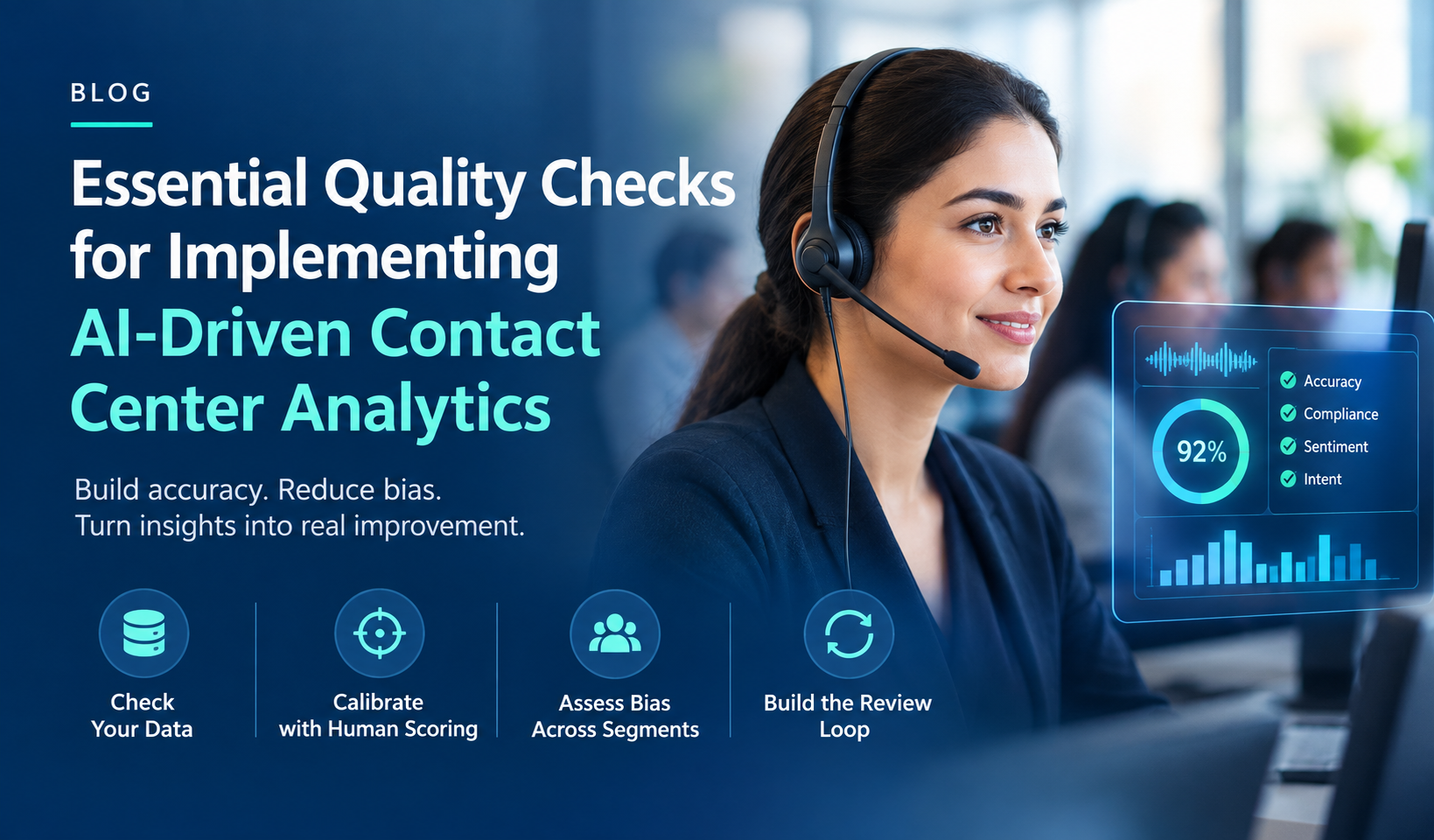
The implementation of AI Analytics in most contact centers are done with the expectation of seeing immediate and reliable insights. Instead, most find scoring drifts, missed flags, and false positives, which quietly erodes trust in the system. Technology is rarely a failure point. The absence of structured quality checks before and during rollout is.
Below are the checks I ask teams to run before they let an AI analytics platform influence coaching, compliance, or performance decisions.
Start with the data the model sees
An analytics model is only as reliable as the interactions it trains and scores against. Before evaluating any output, confirm the input pipeline: call routing tags, transcription accuracy, channel coverage (voice, chat, email), and metadata completeness. A model trained on a transcription error rate above 10% will misclassify sentiment and intent regardless of how well the underlying algorithm performs.
At Etech Global Services, we run a data audit before any scoring model goes live, checking transcription accuracy against a manually reviewed sample, verifying speaker diarization, and confirming that edge cases (crosstalk, accented speech, low-bandwidth calls) are represented in the training set. Skipping this step is the single most common cause of downstream scoring problems we see in client environments.
Calibrate against human scoring before rollout
An AI analytics platform’s own accuracy claims are not sufficient evidence that it works for your program. Before trusting automated scores, run the model against a defined sample of interactions already scored by trained QA analysts, and measure agreement rate by category, not just overall.
This is where QEval® draws a hard line: the platform delivers 100% interaction coverage against the 2–5% industry sampling standard, but coverage only matters if the scores are accurate. Programs that calibrate this way before full rollout typically see quality score lifts in the 20-to-35-point range, because the model is tuned to the program’s actual scoring rubric rather than a generic one.
Audit for scoring bias across agent segments and interaction types
Aggregate accuracy numbers can mask uneven performance. A model might score 92% agreement overall while systematically over-penalizing agents handling complex escalations, or under-detecting compliance issues on shorter calls. Break out agreement rates by call type, agent tenure, and interaction length before treating the model as production ready.
This check matters most in regulated verticals, including insurance, financial services, and healthcare, where a compliance miss carries direct financial and legal exposure. A single blind spot across thousands of monthly interactions compounds fast.
Build the review loop into the coaching workflow
An analytics platform that flags issues without a defined escalation and coaching path produces data, not improvement. Every AI-flagged interaction needs a clear next step: supervisor review, agent notification, or auto-escalation for high-risk categories. Systems that require human oversight at the decision point, not systems marketed as fully autonomous, are the ones that hold up in regulated and high-complexity environments.
Teams that build this loop correctly report roughly 40% reduction in QA effort, because supervisors are reviewing prioritized exceptions instead of manually sampling calls at random.
Frequently asked questions
How long does a quality check cycle take before full deployment?
A calibration and bias audit against a representative sample typically takes two to four weeks, depending on interaction volume and the number of categories being scored.
Does more interaction coverage automatically mean better quality management?
No. Coverage without calibration produces more data, not better decisions. Coverage and accuracy have to be validated together.
Who should own the quality check process, IT or QA?
Both. IT owns data pipeline integrity; QA owns scoring calibration and coaching integration. Neither can validate the system alone.
The gap between an AI analytics platform’s promise and its performance almost always traces back to skipped quality checks, not model failure. Programs that calibrate against human scoring, audit for blind spots, and build a defined coaching loop before scaling see the accuracy and consistency the technology can deliver.
If your team is evaluating or has already deployed an AI analytics platform, run a structured pilot audit against a human-reviewed call sample before expanding it program-wide.

Manu Dwievedi is Vice President, Product Strategy & Innovation at Etech Global Services and ETSLabs. He leads the roadmap for QEval, Voice AI, Real-Time Agent Assist, and Process Automation, the AI platforms running inside Global 2000 enterprise contact centers. Manu joined Etech twelve years ago as a chat representative and worked through operations, training, quality, and analytics before moving into product strategy. He holds an MIT certification in Data Science & Machine Learning.
