



Your AI investment is growing.
Your CX scores aren’t.
Here’s why.
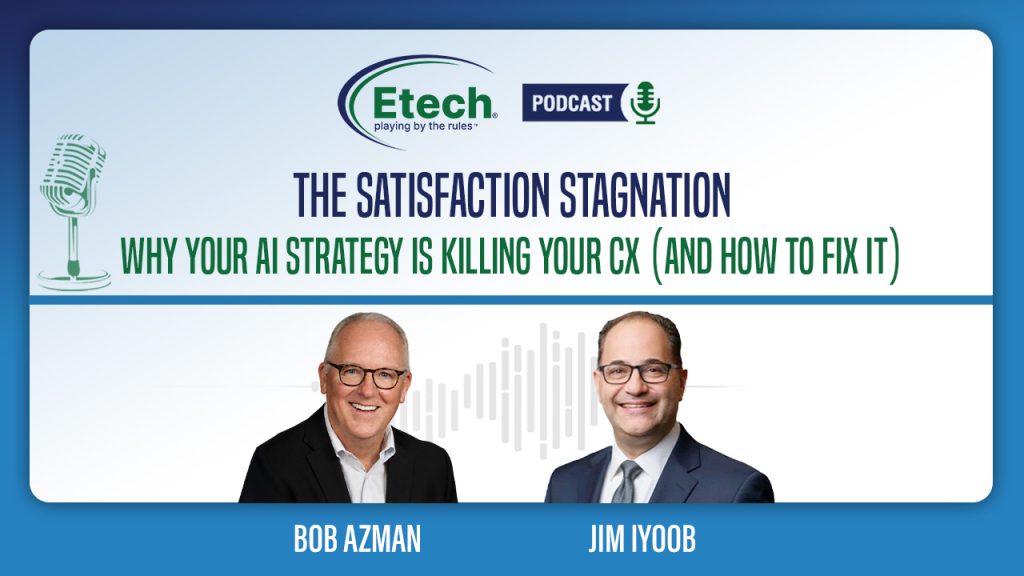
Jim Iyoob and Bob Azman, Founder of InnovativeCX, break down the strategic gap between AI adoption and customer experience results — and the shift leaders need to make right now.
About this episode
AI isn’t the problem. How you’re using it is.
Organizations are spending more on AI than ever before — yet customer satisfaction scores remain flat, complaint volumes stay high, and loyalty is eroding. This episode explores why that gap exists and, more importantly, what leaders can do to close it.
The cost-first trap
Many organizations deploy AI to reduce headcount and handle volume. That mindset produces efficient interactions — but not meaningful ones. Jim and Bob explore why optimizing for cost often destroys the very experiences that drive retention.
Data without direction
Most companies collect more customer data than ever. Few use it to drive measurable CX improvements. This conversation examines the gap between having insights and acting on them — and what a data-informed CX strategy actually looks like.
The survey blind spot
Survey scores capture only a fraction of customer sentiment — and often skew toward extreme experiences. Relying on them as a primary CX metric leads to decisions built on incomplete information. Bob explains what a fuller measurement model looks like.
Human plus AI, not AI instead of human
The most effective CX organizations use AI to handle routine interactions at scale while preserving — and improving — human connection at critical moments. This episode covers how to design that balance intentionally.
What you’ll take away
Practical answers to real CX leadership questions
Each insight in this episode is actionable. Here’s a preview of what Jim and Bob cover.
Why AI investments aren’t moving CX scores
Technology optimized for cost reduction creates faster touchpoints, not better ones. The disconnect starts at the strategy level, not the tool level.
The most common mistake in AI and CX strategy
Treating AI as a workforce reduction tool strips out the human moments that build loyalty — leaving customers faster to reach but less likely to stay.
How to turn data into CX improvements
Insight without a decision framework changes nothing. Learn the loop that connects data collection to action to measurable outcome.
Why you can’t cut your way to CX growth
Cost reduction has a ceiling. Experience improvement does not. Leaders who shift from cost-first to value-first thinking unlock a different kind of growth.
How to balance automation with human connection
Meet the guests
Two CX leaders with decades of real-world experience
Jim Iyoob
Chief Revenue Officer, Etech Global Services & President, ETS Labs
Jim leads revenue strategy and AI innovation across Etech’s global operations. With over two decades in contact center leadership, he brings a practitioner’s view to the gap between AI investment and customer experience outcomes.
Bob Azman
Founder, InnovativeCX | CX Leader | Author | Instructor
Bob has led customer experience transformations across industries for more than 30 years. As founder of InnovativeCX, he advises leaders on building CX strategies that create measurable, lasting results — not just efficiency gains.
Common questions this episode answers
What leaders are asking about AI and customer experience
Why isn’t AI improving customer experience, even with heavy investment?
Most AI deployments are designed to reduce cost and handle volume — not to improve how customers feel about the brand. When the goal is efficiency rather than experience, AI optimizes the wrong outcome. Organizations that see CX improvements from AI start by defining the experience they want to create, then design AI to support that — not the other way around.
What is the biggest mistake companies make when deploying AI in customer service?
The most common mistake is using AI primarily as a headcount reduction tool. This approach strips out the human touchpoints — agent empathy, creative problem solving, relationship building — that are responsible for customer loyalty. The companies getting the most value from AI are using it to free their people to do more of what humans do best.
Why don’t customer surveys give a complete picture of CX performance?
Surveys capture only a fraction of interactions and tend to reflect extreme experiences. The vast majority of customers who had a mediocre experience will not fill out a survey — they will simply not return. Leaders who rely solely on survey data are making strategy on incomplete information. Combining surveys with interaction analytics and behavioral data provides a far more accurate view.
How do you balance AI automation with human connection in customer experience?
The right balance depends on the nature of the interaction. Routine and transactional queries are well-suited to AI for speed and consistency. Complex, emotional, or high-value interactions require human judgment and empathy. The key is designing deliberate handoff points so that AI handles the right moments and humans handle the rest — rather than letting automation expand by default.
Ready to turn your AI strategy into real CX results?
This conversation will change how you think about AI, customer experience, and where the real opportunity sits.
📢 Stay updated with more conversations on leadership, AI, and customer experience — Subscribe to the Etech Leadership & CX Podcast.